From compliance CA to Virtual CFO
Up to 22 times the fee, from the clients you already act for. The same client pays ₹40,000 a year as a tax audit and ₹9,00,000 a year as a Virtual CFO.
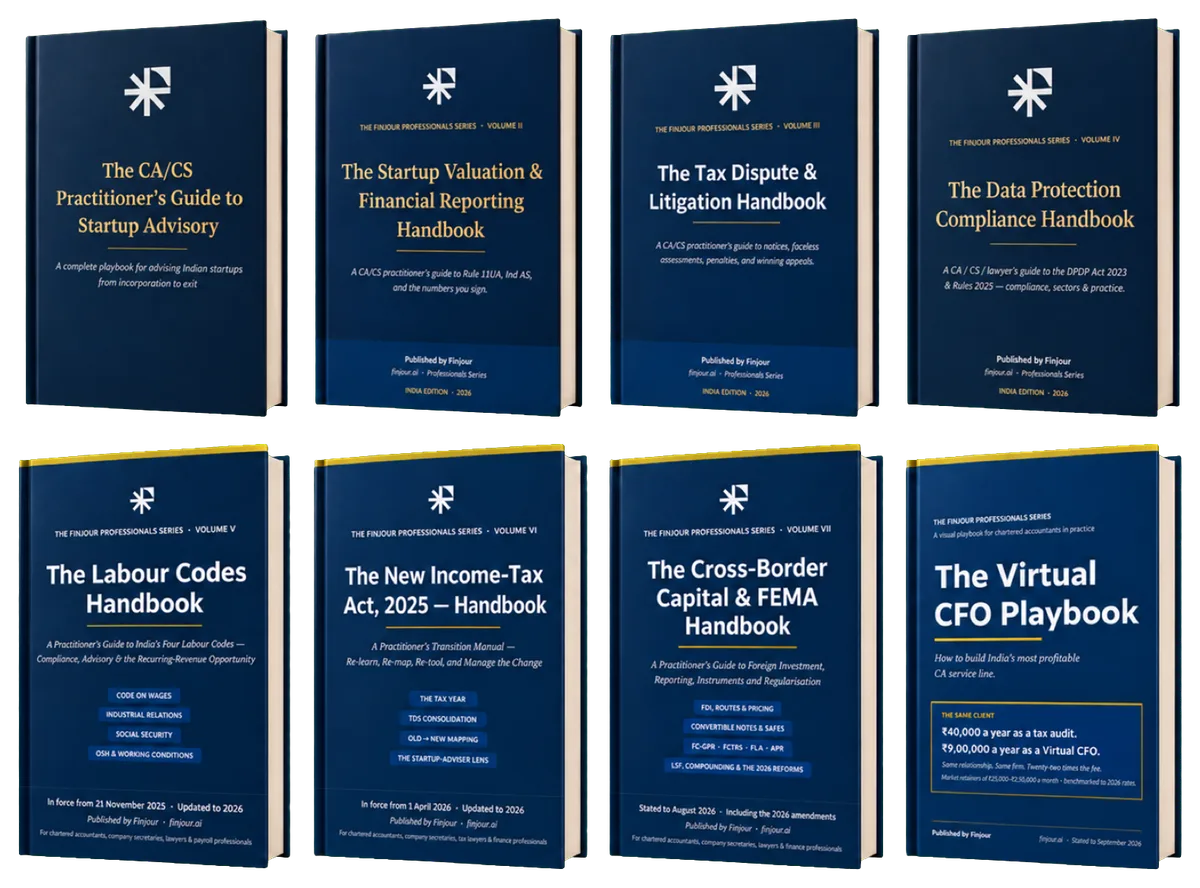
Volume VIII of the Finjour Professionals Series. Stated to September 2026.

What You'll Learn
“I had done versions of this work for years without ever calling it anything or charging for it properly. What this gave me was the structure: a menu, three tiers, and above all a list of what I do not include. I quoted a growth-stage client seventy-five thousand a month last week and did not soften it, because I had the comparison with a full-time finance head ready. The independence chapter also stopped me approaching two clients I could not have taken.”
CA Nikhil R · Pune
Verified purchase
Take a Sneak Peek
The four things that decide whether this line works
A Virtual CFO line is not a repackaging exercise, and it fails far more often on how the firm set it up than on anything the client does. The playbook is organised around the four decisions that settle it, in the order you have to make them.
01
What the service actually is, and whether you can offer it.
The distinction that carries the fee: backward-looking compliance that serves the regulator, against forward-looking work that serves the promoter and is priced against the cost of hiring a CFO rather than another firm's quote. Plus the independence test, because Section 144 decides who you may take before anything else does. Covered in Part 1.
02
The scope, and the exclusions that protect it.
The service menu, the three tiers, and the list of what the retainer does not cover. Almost every engagement that becomes unprofitable does so through scope creep, and the creep is always into work the client assumed was included. Covered in Part 2.
03
The price, anchored to something real.
The published 2026 market bands by client stage, how to price a specific engagement, and the anchor that makes the number defensible: a full-time CFO with the experience to be useful commands roughly ₹40 lakh to ₹1.5 crore a year in fixed CTC, before bonus, ESOPs and the finance team beneath them. Covered in Part 3.
04
The delivery, and the work that wins it.
The reporting pack, the technology stack, the team behind it, and the first ninety days, then where the clients are, how to convert the ones you already act for, the diagnostic conversation, and the proposal. Ending with how to scale the line and the five ways it fails. Covered in Parts 4 to 6.
A compliance practice needs hundreds of clients to reach the revenue a Virtual CFO line reaches with ten. Fewer clients, served deeply, at fees that do not have to be defended against a competitor's quote, which is the definition of leverage in a professional firm. The book puts ten growth-stage retainers at ₹75,000 a month at ₹90,00,000 a year.
Signs the ceiling is already costing you
From a fee you defend to a retainer that recurs
The change is not that you work harder or negotiate better. It is what the fee is compared against. A compliance quote is compared against other firms. A Virtual CFO retainer is compared against the cost of hiring a CFO, and that is roughly ₹40 lakh to ₹1.5 crore a year in fixed pay before anything else. Same firm, same client, different comparison.
Selling compliance
Selling judgement
What the work bills, at 2026 rates
What a Virtual CFO retainer bills in 2026, by client stage, next to what the same client pays you for compliance. The retainer is the default model and it bills every month, which is the whole point. One floor is worth knowing: below roughly ₹40,000 a month, the market reads the service as compliance work with a new label. These are bands, not a tariff, and they follow the client stage and revenue far more closely than they follow your city.
The playbook is ₹2,999. One growth-stage retainer at the middle of the band is ₹75,000 a month, and a fifteen-client line runs to ₹1.35 crore a year. It pays for itself several times over on the first engagement you scope and price properly, and the retainer keeps paying every month after that.
4.8 / 5(7 reviews)
Rated by Indian CA / CS practitioners
“The Section 144 chapter alone was worth it. Two of the clients I had in mind were my own audit clients and I had not thought it through.”
CA Shweta M · Ahmedabad
Verified purchase
“The comparison with what a full-time CFO costs is the thing I now use in every conversation. It changes the whole tone of the fee discussion.”
CA Rajesh V · Indore
Verified purchase
“Practical and well organised. I wanted more on the technology stack than it gives, but the pricing and scoping chapters did the job.”
CA Arun D · Coimbatore
Verified purchase
Why this playbook exists
Every practice we work alongside has the same shape of problem. The compliance fee has not moved in three years, the client list is long, and the work that would actually pay is going to someone the promoter met at a conference. The gap is rarely capability. It is that nobody has written down what the service is, what it costs, and what you say in the room.
Finjour has worked with Indian CAs and CS professionals since 2015, sitting on the other side of exactly this service: the monthly packs, the cash forecasts, the board conversations, and the fundraises they lead into. The questions that came up again and again were not technical. What do I include? What do I charge? What do I refuse to absorb? Which of my own clients can I even take?
That last question is the one most summaries get wrong. Section 144 of the Companies Act, 2013 bars a statutory auditor from rendering certain non-audit services to that audit client, and it reaches the holding company and the subsidiary, directly or through a network firm. This playbook states the position precisely, because a practitioner deciding whether to offer a service needs the line drawn where it actually falls.
10+
Years operating
since 2015
500+
Indian startups
incorporated
100+
Funded rounds
angel · VC · debt
₹100Cr+
Capital raised
by startups we advised
Sectorssole practice · proprietary firms · partnerships · LLPs · small and mid-size firms
The five ways this line actually fails
The book closes honestly. This service fails in five recognisable ways, and only one of them is about the client. The other four are about how the firm set the service up, which means every one of them is preventable.
The monthly cycle slips and the pack is late twice
The client concludes the service is not real: run the cycle to a fixed working day, every month
Delivering a nicer MIS and calling it CFO work
The client notices and prices it accordingly: know the seven differences that carry the fee
Building analysis on records that were never reliable
The analysis gets the blame: establish the records you will rely on in the first ninety days
Absorbing everything the client asks for
Scope creep eats the margin: name every exclusion and price it as a separate engagement
Pricing the engagement from fear
₹25,000 for growth-stage work generates work without generating money: price to the band and the anchor
Offering the service to a client you cannot serve
Section 144 reaches the audit client, its holding company and its subsidiary, including through a network firm

22x
the annual fee from one client, a tax audit against a growth-stage retainer
₹25k to ₹2.5L
the published 2026 monthly retainer band, by client stage
₹40L to ₹1.5cr
the fixed CTC a full-time CFO commands, which is what your fee is compared against
8th working day
whether the pack arrives on time is the strongest predictor that the engagement renews
“The Section 144 chapter saved me from a mistake. Two of the clients I had in mind were my own audit clients.”
— CA Shweta M · Ahmedabad
What You'll Walk Away With
Price against a CFO's salary, not another firm's quote
The single change that lifts the fee. A full-time CFO commands roughly ₹40 lakh to ₹1.5 crore a year in fixed CTC, and once that is the comparison in the room, a ₹75,000 monthly retainer reads as the economical option rather than an expensive one.
Know exactly which clients you may take
Section 144 of the Companies Act, 2013 stated precisely rather than summarised loosely, including that it reaches the holding company and the subsidiary and applies through a network firm. The test takes one minute and it decides the whole engagement.
Scope it so it stays profitable
The exclusion list is the chapter that protects the margin. Almost every engagement that turns unprofitable does so through scope creep into work the client assumed was covered, and the playbook names every line and how to price it separately.
Convert clients you already act for
The fastest route to a first engagement is a business already on your list. You have the records, the relationship and the context, and the playbook covers the conversation that moves it from annual to monthly.
Build a line that survives its own growth
Three clients at ₹27 lakh a year, eight at ₹72 lakh, fifteen at ₹1.35 crore, with the monthly cycle, the team structure and the technology decisions that have to change at each step, and the five documented ways the line fails if they do not.
“Quoted seventy-five thousand a month for the first time last week without softening it. The CFO cost comparison is what made that possible.”
— CA Arun D · Coimbatore

22 Chapters of Actionable Content
64 pages of structured, India-specific reference material.
Why compliance cannot be priced upward: every firm offers the identical deliverable, the client compares quotes line for line, the recommended scale becomes a ceiling rather than a floor, and software now produces much of the visible output. The structural position the rest of the book is an escape from.
“I had been thinking about this for two years without doing anything. The service menu and the exclusion list were what I was missing.”
— CA Nikhil R · Pune
Compliance work vs a Virtual CFO line
The complete playbook — ₹2999
Everything in one download. One-time payment, lifetime access.
Today, as one download
One-time payment. Indian payment methods accepted (UPI, cards, net banking).
- Instant download: one PDF with all seven toolkit templates inside
Common Questions
Not if the client is a company and you are its statutory auditor. Section 144 of the Companies Act, 2013 prohibits a statutory auditor from rendering certain enumerated non-audit services to the audit client, and to its holding company and its subsidiary, directly or indirectly, which extends to provision through a network firm. Two of the enumerated categories bear on this service: accounting and book-keeping, and management services. Chapter 7 states the position precisely, including where the Code of Ethics prohibition on assuming a management responsibility applies even when the client is not a company and Section 144 does not apply by its terms. Getting this wrong is not a pricing error, so the book draws the line where it actually falls rather than summarising it loosely.
You already have the clients. Offer them the service.
Join the practitioners who stopped defending a compliance fee against every other firm in the city and started billing a monthly retainer against the cost of the CFO their client cannot afford to hire.
Complete the series
The other titles, and the set that carries all 8 as one download.