Sign the ₹2+ lakh valuations you've been referring out
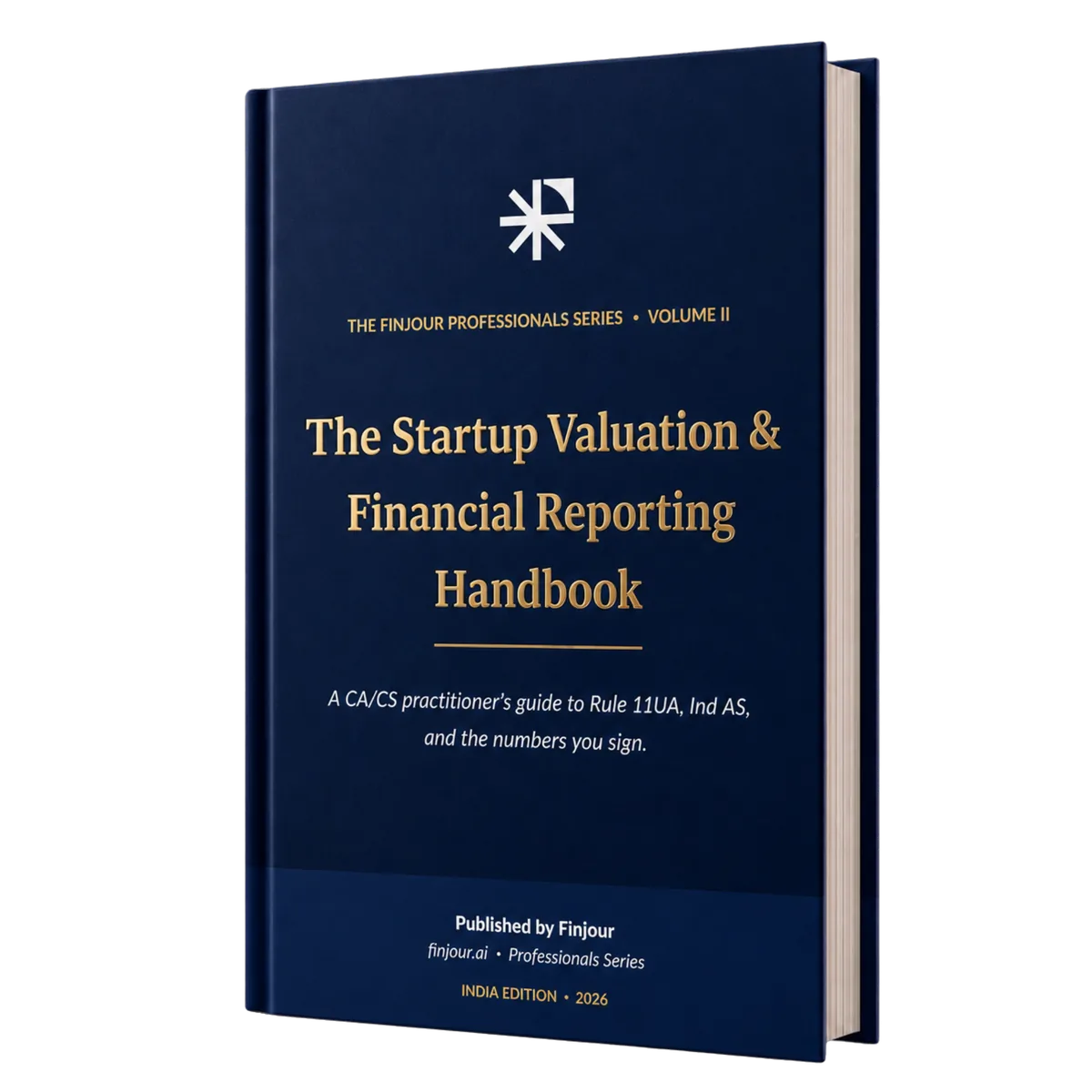
Rule 11UA, Ind AS 102 / 109 / 115 / 113, the funded-startup audit, and the IPO valuation bridge. The technical core of startup financial work the generalist hands away and the specialist gets paid for.
From the team behind 500+ Indian startup incorporations since 2015. 100+ of those companies have raised ₹100+ crore in angel, VC, and debt funding. Volume II goes deep into the technical core (valuations, accounting standards, audit opinions) that carries the highest fees and the steepest learning curve.
What You'll Learn
“This is the depth that lets us keep the most valuable work in-house. The Rule 11UA mechanics, the CCPS classification trap, and the diligence-ready audit-file discipline are exactly the three places we were losing fees and credibility.”
CA Deepak Bhasi
Startup Advisor & Fundraising Specialist
Take a Sneak Peek
The four bodies of knowledge this book builds
Mastering the valuation and reporting frontier means becoming competent in four connected bodies of knowledge. They are connected because a single engagement frequently touches all four: a funding round needs a Rule 11UA valuation (statutory framework), which prices CCPS (instrument valuation), which must then be classified and measured (accounting standards), and ultimately audited (the startup audit). This book is organised around these four, in this order.
01
The statutory valuation framework.
Rule 11UA and its NAV and DCF methods, the post-angel-tax landscape (Sections 50CA, 56(2)(x)), and FEMA pricing guidelines. This is where a valuation becomes a certificate someone files and relies on. Covered in Part II.
02
Instrument valuation.
The equity waterfall, CCPS and their liquidation preferences, convertibles and SAFEs, the defensible DCF for a company with no earnings, and the re-pricing math of down rounds and anti-dilution. This is where judgement meets arithmetic. Covered in Part III.
03
The accounting standards.
Ind AS 102 for ESOPs, Ind AS 109 for financial instruments, Ind AS 115 for revenue, and Ind AS 113 for fair value. This is where the instruments land in the financial statements. Covered in Part IV.
04
The startup audit.
The funded-company statutory audit, internal financial controls and materiality under burn, going concern and related-party judgement, and the diligence-ready audit file. This is where the practitioner signs their name and accepts liability. Covered in Part V.
A single funded startup, across one financial year with one priced round, can generate valuation, ESOP, audit, and diligence engagements that together exceed the practice's entire annual billing on a comparable traditional client. The practitioner who can perform and sign this work captures it; the one who refers it out keeps only the compliance crumbs.
Common signs you're hitting the edge of generalist competence
What separates a generalist from a valuation & reporting specialist
Valuation and reporting capability is not a per-client cost; it is a fixed investment that pays out across every startup client a practice serves. Learn the DCF once; it applies to every valuation engagement thereafter. Learn the Ind AS 102 ESOP computation once; every funded client's annual charge becomes work you keep in-house.
Without this handbook
With this handbook
The fee math, before you even read the book
From Chapter 1.2: indicative 2026 fee ranges for the principal valuation and reporting engagements a funded Indian startup generates each year. These are working ranges observed across the ecosystem; they vary by city, practice tier, and company complexity.
This handbook pays itself back at the first Rule 11UA valuation you no longer have to refer out.
4.8 / 5(12 reviews)
Rated by Indian CA / CS practitioners
“Chapter 3 on Rule 11UA is the clearest treatment of the post-2023 amendments and the 90-day window I've come across.”
CA Anand Iyer
Partner, mid-size CA firm · Bangalore
“The 'who can sign what' map in Chapter 2 is essential. It states the practitioner / merchant-banker boundary in one page.”
CS Meera Krishnan
Independent practice · Chennai
“The fixed-for-fixed test in Chapter 11 is now the first thing we apply when a client's CCPS terms come in. Standard reading on the team.”
Vivek Bhatia
Senior Associate, Tier-1 law firm · Mumbai
“The Appendix B worked models (NAV, DCF, the safe-harbour test, the ESOP expense) are what a working file actually looks like.”
CA Rohit Banerjee
Practice partner · Kolkata
“The FEMA pricing chapter and its reconciliation to Rule 11UA is the cleanest treatment of the two-valuation reality I've seen.”
CS Pranav Joshi
Independent practice · Pune
“The treatment of Section 50CA, 56(2)(x), and the post-angel-tax landscape is the reference my practice was missing.”
Aarti Subramanian
Tax counsel · Bengaluru
Built on real engagements
The team behind Finjour has been incorporating and advising Indian startups since 2015, with 500+ to date, with 100+ of them going on to raise ₹100 crore+ in angel, VC, or debt funding. We've drafted the Founders' Agreements, run the Rule 11UA valuations, structured the SAFEs, signed off on FC-GPRs, and delivered the data-room artefacts that close those rounds.
Every opinion in this book is grounded in the relevant statute, rule, or circular. Every process recommended is one we've seen tested in a live engagement, not hypothetical, not borrowed from a US textbook, not generated by AI.
The CA / CS practitioners we work alongside told us, repeatedly, what they wished existed. This is that book.
10+
Years operating
since 2015
500+
Indian startups
incorporated
100+
Funded rounds
angel · VC · debt
₹100Cr+
Capital raised
by startups we advised
SectorsSaaS · D2C · fintech · AI/ML · marketplaces · edtech
The engagement risks this handbook helps you eliminate
Each chapter addresses a specific error that costs practitioners fees, files, or liability, and every mistake is drawn from a CAUTION box in the book.
Signing a DCF as a CA when the purpose required SEBI-registered merchant-banker certification
Reference map of valuation purpose to authorised signer; the DCF / merchant-banker boundary stated explicitly
Missing the cascading valuation under Rule 11UA component C: treating unquoted investments at book value
Component C requires unquoted shares and securities held to be re-valued under Rule 11UA, not taken at book
Treating a CCPS as equity by default, then triggering Ind AS 109 liability classification at diligence
Apply the fixed-for-fixed test to every conversion feature; check variable-share, redemption, and dividend obligations
Recognising SaaS annual billing as revenue on receipt, the most common Ind AS 115 audit finding
The five-step model, recognised over the service period. ₹12,000 upfront for 12 months recognises as ₹1,000 per month.
Omitting the Ind AS 102 ESOP expense, when a startup with a live ESOP pool and no expense has materially misstated P&L
Option-pricing fair value at grant date, expense over the vesting period, true up for service-condition forfeitures

18
Chapters Across 7 Parts
73
Pages of Practitioner Reference
4
Worked Models in Appendix B
5
Engagement-type Checklists (Appendix C)
“The CCPS classification trap in Chapter 11 is the one we now check on every engagement. The fixed-for-fixed test is the difference between an investor's money sitting cleanly in equity and the same money triggering liability treatment with P&L volatility from derivative re-measurement.”
— CA Deepak Bhasi · Startup Advisor & Fundraising Specialist
What You'll Walk Away With
Rule 11UA valuation, signed in-house
₹25000NAV component-by-component, DCF defensibility, the 2023 amendments, the 90-day window, the 10% safe-harbour tolerance: enough to scope and sign Rule 11UA valuations that survive an assessing officer's scrutiny.
CCPS, convertibles, and the waterfall
₹20000Read full CCPS terms, build the liquidation waterfall, value common equity using the waterfall (not headline share count), and distinguish valuation from Ind AS 109 classification. Models that survive diligence re-performance.
ESOP fair value under Ind AS 102
₹18000Option-pricing fair value at grant date, expense over the vesting period, the four vesting-condition treatments. Worked Ind AS 102 expense schedule in Appendix B. Stop quoting back-of-envelope intrinsic values.
Revenue under Ind AS 115, by business model
₹15000The five-step model applied to SaaS, marketplaces, D2C, and subscription. SaaS deferred revenue, marketplace principal/agent control test, D2C returns provisions. Never let GMV be presented as revenue.
Funded-startup audit + diligence-ready file
₹22000Scope to the distinct risks, select materiality benchmarks that fit a high-burn company, assess going concern on evidence, document every significant judgement with basis. Build the audit file once, defend it under VDD re-performance.
The valuation & reporting practice itself
₹10000Engagement-letter scoping, pricing for value and liability, restricting reliance, contemporaneous documentation, knowing when to decline. The chapter that turns the technical handbook into a sustainable specialist practice.
“The 'who can sign what' reference map in Chapter 2 alone is worth the price of the book. The DCF / merchant-banker boundary is where practitioners go wrong, and the Master Checklist Library in Appendix C makes it impossible to miss before you accept the engagement.”
— CA Deepak Bhasi · Startup Advisor & Fundraising Specialist

18 Chapters of Actionable Content
73 pages of structured, India-specific reference material.
Why valuation and reporting became the practitioner's frontier: instruments got complex, Ind AS adoption brought share-based-payment, financial-instrument, revenue, and fair-value accounting into startup financials, and diligence intensified. With indicative 2026 fee ranges by engagement type.
“Chapter 6 on the equity waterfall and Chapter 8 on the pre-revenue DCF are the two I keep going back to. The worked numbers in Appendix B (NAV, DCF, the safe-harbour test, the ESOP expense schedule) are exactly what a working file looks like.”
— CA Deepak Bhasi · Startup Advisor & Fundraising Specialist
This handbook vs generalist audit and valuation practice
The complete technical handbook — ₹2499
Everything in one download. One-time payment, lifetime access.
Today, as one handbook
One-time payment. Indian payment methods accepted (UPI, cards, wallets, net banking).
- Instant PDF download with worked models and checklists inside the same file
- One-time payment · UPI, cards, wallets, net banking
Common Questions
Chartered Accountants, Company Secretaries, Cost & Management Accountants, registered valuers, and lawyers who advise Indian startups and have reached the edge of what general practice prepared them for. The book is a working desk reference for the technical core (valuations, accounting standards, audit opinions), not an introduction to startup advisory. Volume I of the series covers that ground.
Stop referring out the work that defines the engagement.
Join the practitioners building specialised valuation and reporting practices around the technical core of startup advisory.