Get compliant under India's four new Labour Codes, before the penalties bite
A working handbook for two readers at once: the Chartered Accountants, Company Secretaries, and labour advisers who guide clients, and the in-house HR, payroll, accounts, and finance teams who must get their own employer compliant. On 21 November 2025 the four Codes replaced 29 central labour Acts, the new definition of wages forces basic pay to at least 50% of total remuneration, and every wage definition, PF and ESI contribution, register, and filing now has to be redone. Get it wrong and the exposure is real. This is the one book that gets your practice, and your payroll, compliant before the deadlines bite.
From the team behind 500+ Indian startup incorporations since 2015. The timing is once-in-a-generation: on 21 November 2025 four Codes replaced 29 labour Acts, the new definition of wages forces basic pay to at least 50% of CTC, and almost every employer must restructure. If you advise clients, this is a fresh recurring line. If you run HR, payroll, or finance in-house, this is the re-compliance you have to deliver now.
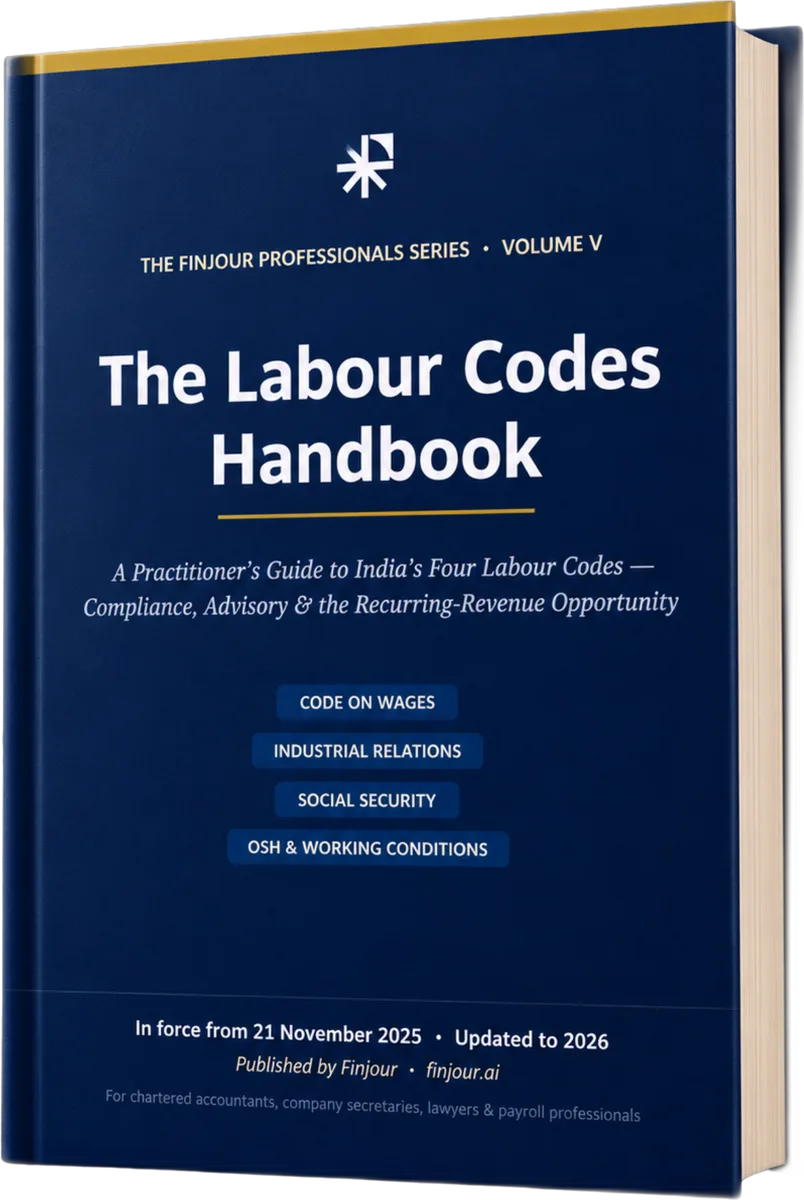
What You'll Learn
“I lead HR and payroll in-house, and once the Codes came in I had to get our own structures compliant fast. This laid it out plainly: the 50% wage rule, what it does to PF and gratuity, and the order to do the work in. We redid the CTCs and fixed the filings without a last-minute panic, and I used the checklist to brief our finance team. For the price it is easily worth it, and it is just as useful if you are advising clients rather than doing it yourself.”
Sneha R · Gurugram
Verified purchase
Take a Sneak Peek
The four things every employer now has to get right
Re-compliance under the four Codes is mandatory, and it is the same map whether you advise clients or run payroll in-house. A single employer moves through all four stages: the reform creates the obligation (from 29 laws to four Codes), the new wage definition creates the cost (the CTC-restructuring problem), the Codes set out the duties and the penalties (obligations, offences, and compounding), and the whole thing has to be delivered, priced by an adviser as recurring revenue, or run by the in-house team as a standing programme. This book is organised around these four.
01
The reform and why it cannot wait.
Why the move from 29 central Acts to four Codes on 21 November 2025 is a mandatory reset, what changed and for whom, and the four Codes at a glance. Almost every employer in India must now re-comply, and the clock has started. Covered in the opening chapters.
02
The new definition of wages and the CTC problem.
The statutory rule that basic wages must be at least 50% of total remuneration, why most Indian salary structures break it, the restructuring almost every employer now faces, and the worked PF and gratuity impact of the change. The concept every engagement, and every in-house payroll, rests on. Covered in the wages chapters.
03
Obligations, penalties, and applicability.
Employer obligations code by code, the new compliance architecture, and the penalties regime, which now largely decriminalises offences into fine-only breaches, most of them compoundable by paying 75% of the maximum fine. Plus the applicability and threshold matrix that tells you which duties bite for a given employer. Covered in the obligations and enforcement chapters.
04
Getting it done, and keeping it done.
The engagement types and how to scope them, fees and packaging into Essentials, Complete, and Managed tiers for the adviser, and the same implementation path for the in-house team, so a restructuring is delivered and the monthly compliance keeps running. Covered in the practice chapters.
A labour-compliance programme is the rare work that does not end when the project ends. A CTC restructuring is delivered once, but the payroll runs, the filings, the registers, and the standing orders recur every month. For the adviser that is a managed retainer and recurring revenue on a sticky relationship. For the in-house team it is the standing compliance the employer now has to keep alive. Either way, that ongoing work is exactly what this book builds.
Signs you are not ready for the Codes, whether you advise clients or run payroll in-house
From unprepared and exposed to compliant and in control
Re-compliance under the four Codes is mandatory, it touches almost every employer, and it carries a real cost that a board must decide on. For the adviser it also recurs, a restructuring followed by a monthly retainer. For the in-house team it is a programme that has to keep running. What separates the employer that is compliant and in control from the one that gets caught out is method, and method can be learned.
Meeting the new Codes without a method
Getting compliant with the Labour Codes playbook
The fee math, and the exposure math
From Chapter 17 (Figure 17.1): indicative 2026 fee ranges, GST-exclusive, for the principal labour-codes engagements almost every Indian employer now generates. Each range spans a small employer at the low end to a large one at the high end. For the external adviser, this is the fee you can bill. For the in-house HR, payroll, or finance team, it is the same work priced out, either the cost of engaging it, or the value of the exposure avoided by getting it right in time. The managed retainer recurs, billed month after month. These are working ranges observed across the ecosystem; they vary by city, practice tier, and headcount.
The handbook is ₹1,999. For the adviser, one CTC-restructuring engagement, or a single month of a managed retainer, pays it back many times over, and the retainer keeps paying every month. For the in-house team, it costs less than an hour of the exposure it helps you avoid: getting the wage definition, the PF and gratuity base, and the filings right before the penalties bite. It pays for itself the first time it saves you a mistake or wins you an engagement.
4.8 / 5(8 reviews)
Rated by Indian CA / CS practitioners
“The section on pricing and retainers was worth the whole book for me. Finally clear on what this work is actually worth to bill.”
CA Rohit A · Pune
Verified purchase
“Read this as the finance lead at a manufacturing firm. It made the PF and gratuity numbers concrete and gave me exactly what I needed to take to the board.”
Vikram S · Noida
Verified purchase
“Solid overview and very current. Would have liked a couple more worked examples, but for the price I am not complaining.”
Aarti S · Bengaluru
Verified purchase
Built on real engagements
The team behind Finjour has been incorporating and advising Indian startups since 2015, with 500+ to date, and 100+ of them going on to raise ₹100 crore+ in angel, VC, or debt funding. We have run the payrolls, structured the CTCs, filed the PF and ESI, and drafted the employment terms that the four Labour Codes now reshape, which is exactly why we can show both the adviser and the in-house team where the re-compliance work, the cost, and the fees sit.
Every rule in this book is grounded in the four Labour Codes, the Code on Wages 2019, the Industrial Relations Code 2020, the Code on Social Security 2020, and the OSH and Working Conditions Code 2020, and mapped back to the 29 central Acts they replace, not borrowed from a foreign textbook or generated by AI.
The CA, CS, and advocate practitioners we work alongside, and the in-house HR, payroll, and finance leads inside the companies we serve, told us, repeatedly, what they wished existed for the moment the question lands: how do the new Codes change this payroll. This is that book.
10+
Years operating
since 2015
500+
Indian startups
incorporated
100+
Funded rounds
angel · VC · debt
₹100Cr+
Capital raised
by startups we advised
Sectorsmanufacturing · IT & SaaS · retail · logistics · staffing · hospitality · construction · BPO
The mistakes that leave an employer exposed
Labour-codes work is high-value and high-exposure in equal measure. These are the errors that leave an employer non-compliant, or an adviser leaving revenue on the table, and where the book addresses each.
Assuming the existing salary structure still complies
The 50% basic-wage rule breaks most structures: place the employer and scope the restructuring
Treating the re-compliance as a one-time task that is now done
The payroll, filings, and registers recur every month: build the ongoing programme, or retainer
Underestimating the PF and gratuity cost of the change
The worked ₹30,000 to ₹50,000 example: PF from ₹7,200 to ₹12,000, gratuity up about half again
Mishandling the transition and creating backdated exposure
Stage the migration and standing orders so the backdated PF and gratuity risk does not build
Not knowing the penalties or the way out of them
Most offences are now fine-only and compoundable at 75% of the maximum fine
Getting the applicability threshold wrong for an employer
Read the employer against the applicability and threshold matrix before acting

4 Codes
now replace the 29 central labour Acts they consolidate
50%
the minimum share of total remuneration that basic wages must be
75%
of the maximum fine compounds most offences, now largely fine-only
21 Nov 2025
the date the four Codes came into force and the clock started
“The urgency framing helped me raise it with clients before they got caught out. Picked up two restructuring jobs off the back of it.”
— CA Deepak B · Kochi
What You'll Walk Away With
Model the 50% wage-floor impact with confidence
When the question lands, what does the new definition of wages do to this payroll, you will be able to show it: the PF that rises in step, the gratuity that rises about half as much again, and the backdated exposure of getting the transition wrong. The judgement that starts the work, whether you advise it or run it.
Lead or run the CTC restructuring
Almost every Indian employer must restructure its CTC to meet the 50% basic-wage rule. You will know how to scope the restructuring, stage the transition, and deliver it so the employer complies without an avoidable cost shock, as an adviser for a client or as the in-house team for your own company.
Cover all four Codes
The Code on Wages, the Industrial Relations Code, the Code on Social Security, and the OSH and Working Conditions Code, with the obligations mapped code by code so you can tell any employer exactly what they must now do.
Price it, or budget it, correctly
The managed compliance retainer and the fee templates to price the readiness review, the restructuring, and the retainer for advisers, and the same figures for in-house teams to budget the work and weigh it against the exposure of getting it wrong.
Place any employer on the matrix
The applicability and threshold matrix and the sector view, so you can tell any employer which duties bite, where the re-compliance work sits, and what the penalties and compounding route look like if they get it wrong.
“Straight to the point and current. The worked PF and gratuity numbers were exactly what I needed to take to our finance head.”
— Nidhi A · Ahmedabad

20 Chapters of Actionable Content
56 pages of structured, India-specific reference material.
How India replaced 29 central labour Acts with four Codes on 21 November 2025, why the consolidation matters, and why almost every employer must now re-comply. The starting point for the whole practice.
“I run payroll in-house and this told me exactly what to change and in what order. We redid the CTCs before year-end without a panic.”
— Sneha R · Gurugram
Exposed and scrambling vs compliant and in control
Common Questions
Yes, directly. Half the book is written for the in-house team that has to re-comply its own employer. It walks you through the new wage definition, how to redo your salary structures so basic is at least 50%, how PF, ESI, and gratuity change on the new base with worked numbers, and how to fix your registers and filings under the four Codes. You get the same worksheet, checklist, and applicability matrix an external adviser would use, so you can plan and run the work yourself.
The Codes are live and the clock has started. Get compliant before it bites.
Join the advisers and in-house teams who meet the four Codes with a plan, redo the wage definitions, PF, ESI, and filings almost every employer now needs, and turn a mandatory reset into work that is delivered right, and kept right, month after month.