Become the practitioner who is fluent in the new Act before your clients even ask.
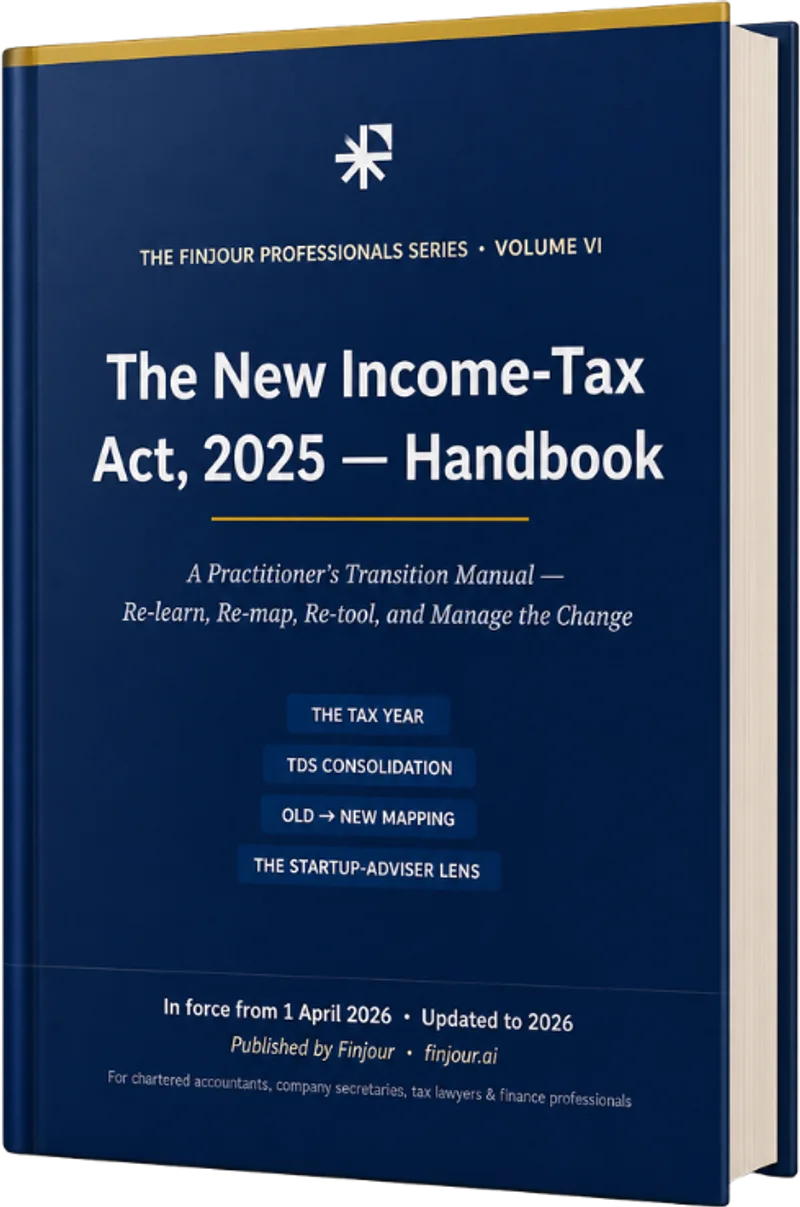
A working handbook for CAs, CSs, tax lawyers, and finance teams facing the first rewrite of India's income-tax law in 65 years. On 1 April 2026 the Income-tax Act, 2025 replaced the Income-tax Act, 1961. The tax did not change: same rates, same heads, same deductions. The statute did: new structure, new language, new section numbers, new forms. Nobody has to re-learn tax, but every practitioner has to re-learn the map, re-cite every reference, re-tool every template, and run two Acts side by side through Tax Year 2026-27. The one who gets fluent first looks like the expert in every client room. This is the book that gets you there, with a deep startup-adviser thread most summaries will never carry.
From the team behind 500+ Indian startup incorporations since 2015. The timing is once in 65 years: on 1 April 2026 the Income-tax Act, 2025 replaced the 1961 Act. The tax policy did not change, but the whole statute did, structure, language, numbering, and forms. Every practitioner must re-learn the map, re-cite every reference, and run two Acts side by side through 2026-27. The one who gets fluent first is the expert in every client room.
What You'll Learn
“When the new Act came in I had a stack of client files still citing the old sections, and I needed to get current fast. This laid out plainly what changed and what did not, gave me the old-to-new map, and got the TDS codes and the ESOP workings straight in my head. I was answering client questions with confidence inside a week instead of hunting for sections. For the price it is an easy yes, and the startup chapters alone earned it back on the first engagement.”
CA Sanjay P · Mumbai
Verified purchase
Take a Sneak Peek
The four things every practitioner now has to get right
Getting fluent in the new Act is not optional, and it follows the same path whether you advise clients or run tax in-house. You move through four stages: understand the reform and what did not change, master the structural shifts that touch daily practice, re-map every provision you know from the old Act to the new one, and manage the dual-Act transition while you re-tool the practice around it. This book is organised around these four.
01
The reform, and what did not change.
Why the move from the 1961 Act to the 2025 Act on 1 April 2026 is the rewrite of a lifetime, why the tax itself is unchanged (same rates, heads, and deductions), and why that makes fluency a matter of the map, not the policy. Covered in the opening chapters.
02
The structural shifts that change practice.
The unified Tax Year replacing Previous and Assessment Year, the consolidation of 40-plus TDS sections into Secs. 392 to 394 with payment codes 1001 to 1067, tables and formulae in place of narrative prose, and the renumbering of almost every section. The shifts you feel in daily work. Covered in the structural chapters.
03
The old-to-new re-mapping.
How to find a provision you know when its number has moved, the key section map, the official Income Tax Department mapping, the dual-citation discipline, and the new forms and rules regime. The reference you reach for on every file. Covered in the re-mapping chapters.
04
The transition, and the opportunity.
Running two Acts at once under Sec. 536, handling pending assessments and appeals, avoiding the transition traps, re-tooling templates and software, and capturing the first-mover advantage a new tax code creates. Covered in the transition and practice chapters.
A new tax code is a rare event, the last one lasted 65 years, and it temporarily resets who the expert is. The practitioner who gets fluent first captures disproportionate trust and work while everyone else is still hunting for the old section number. Depth beats breadth: a generalist summary is a commodity, while running an ESOP deferral, preserving a startup's carried-forward losses, and re-basing a funded company's TDS stack is not. That first-mover fluency is exactly what this book builds.
Signs you are not yet fluent in the new Act, whether you advise clients or run tax in-house
From hunting for the old section to fluent in the new Act
The rewrite touches every practitioner, the tax underneath is the same, and the window in which fluency sets you apart is short. What separates the practitioner who looks like the expert from the one still hunting for the old section number is the map, and the map can be learned. Get it, and you move fast while everyone else catches up.
Meeting the new Act without a map
Getting fluent with the new-Act playbook
What fluency is worth, in the window that only opens once in 65 years
This is not a fee schedule; the book quotes none. It is the value of being fluent first. A new tax code resets who the expert looks like, and the reset does not last. Through Tax Year 2026-27 you will run two Acts side by side, and the practitioner who can already do the hard, billable, startup-adviser work below, without fumbling for a section number, wins the trust and the engagements while everyone else is still catching up. These are the concrete client situations fluency lets you handle, straight from the worked examples in the book.
The handbook is ₹1,999. The fluency window is once in 65 years. Get one ESOP deferral, one funding-round loss carry-forward, or one TDS re-base right before a client asks, and you have made the expense back many times over, in a role no generalist summary can take from you.
4.8 / 5(9 reviews)
Rated by Indian CA / CS practitioners
“The startup and ESOP portions were the reason I bought it and they delivered. Ran a deferral and a capital-gains working for a client without any hand-holding.”
Meghna T · Delhi
Verified purchase
“Got our whole finance team onto the new citations and the TDS codes in days. The old-to-new map is the part I keep coming back to.”
Arun N · Chennai
Verified purchase
“Very current and genuinely useful through the transition. Would have liked a few more worked examples, but for the price I am not complaining.”
Kavya S · Bengaluru
Verified purchase
Built on real engagements
The team behind Finjour has been incorporating and advising Indian startups since 2015, with 500+ to date, and 100+ of them going on to raise ₹100 crore+ in angel, VC, or debt funding. We have run the ESOP grants, the funding-round diligence, the capital-gains and TDS workings, and the filings that the new Act now re-maps, which is exactly why we can show you where the fluency work sits and where the startup-adviser edge is.
Every rule in this book is grounded in the Income-tax Act, 2025 itself, the Income-tax Rules, 2026, and the official Income Tax Department section-wise mapping from the 1961 Act, not borrowed from a foreign textbook or generated by AI.
The CA, CS, and tax-lawyer practitioners we work alongside, and the in-house finance leads inside the companies we serve, told us, repeatedly, what they wished existed for the moment the rewrite lands: a clear map from the Act you know to the Act you now have to cite. This is that book.
10+
Years operating
since 2015
500+
Indian startups
incorporated
100+
Funded rounds
angel · VC · debt
₹100Cr+
Capital raised
by startups we advised
SectorsIT & SaaS · fintech · D2C · manufacturing · services · professional practice · startups · funded companies
The mistakes that give away that you are not yet fluent
New-Act work is high-value and high-visibility in equal measure. These are the errors that mark a practitioner as behind, or leave the defensible startup work on the table, and where the book addresses each.
Assuming the tax changed and re-learning it from scratch
Same tax, new statute: re-learn the map, not the policy, and move fast
Trying to infer a new section number from the old one
Numbering is not a fixed offset: use the master map and dual-cite every reference
Leaving payroll and software on the old 194-series
Re-base the TDS stack to Secs. 392 to 394 and the codes 1001 to 1067 first
Fumbling the ESOP and capital-gains workings
The worked ESOP deferral and the ₹46,875 long-term gain, done step by step
Applying the wrong Act to a period, or writing Assessment Year
Sec. 536 sets the boundary by the date income was earned: apply it, avoid the traps
Publishing a generic summary and competing on breadth
Depth on the startup thread is the defensible, first-mover work no summary matches

65 years
since the last income-tax code, now replaced on 1 April 2026
819→536
sections after the rewrite, almost all of them renumbered under the new Act
392-394
the three sections that now carry every TDS and TCS provision, via codes 1001 to 1067
2026-27
the first Tax Year under the new Act, run alongside the old one
“The startup chapters were the reason I bought it, and they paid off. Handled an ESOP deferral for a client without a single fumble.”
— Priya D · Bengaluru
What You'll Walk Away With
Get fluent in the new Act fast
When the rewrite lands and a client asks how the new Act affects them, you will answer without hunting for a section. You will know what changed (the map), what did not (the tax), and how to cite the new statute cleanly, the fluency that makes you the expert in the room.
Master the structural shifts
The unified Tax Year, the TDS and TCS consolidation into Secs. 392 to 394 with codes 1001 to 1067, and the renumbering of almost every section, so the changes you feel in daily work do not slow you down or trip up a notice, return, or certificate.
Re-map every provision you know
The master old-to-new section map, the safe-to-cite core, and the dual-citation discipline, so you can find a familiar provision under its new number and cite it with confidence, on every file, from day one of the transition.
Own the startup-adviser edge
Run an ESOP exercise-and-deferral, preserve a startup's carried-forward losses through a funding round, and handle capital gains and VDAs under the new Act, the most valuable and most defensible work, with the numbers worked out for you.
Run two Acts without a slip
The dual-Act transition under Sec. 536, the way pending assessments and case law carry across, and the four transition traps, so you apply the right Act to the right period and re-tool the practice around it without a misstep.
“Current and to the point. Got our whole team onto the new citations and the TDS codes in a week instead of a quarter.”
— Anil K · Hyderabad

20 Chapters of Actionable Content
50 pages of structured, India-specific reference material.
How the Income-tax Act, 2025 replaced the 1961 Act on 1 April 2026, why a statute that began with 298 sections had swollen to 819 after roughly 4,000 amendments, and why this is the rewrite of a lifetime.
“I stopped guessing at the new section numbers. This gave me the map and I now cite the new Act without second-guessing myself.”
— CA Rohan M · Pune
Hunting for the old section vs fluent in the new Act
Common Questions
No, and that is the whole point. The tax did not change: the rates, the five heads, and the deductions all survive, and the new regime is still the default. What changed is the statute around the tax, its structure, language, section numbers, and forms. This book teaches you the new map, not new tax, so you can cite and apply the Act you now have to work with.
The Act is rewritten and the window is open. Get fluent before your clients ask.
Join the practitioners who meet the new Income-tax Act with a map, cite it cleanly from day one, run the ESOP, capital-gains, and TDS work no generic summary touches, and turn a once-in-65-years rewrite into the moment they become the expert in every client room.