Advise on foreign money with confidence, and build the practice that comes with it
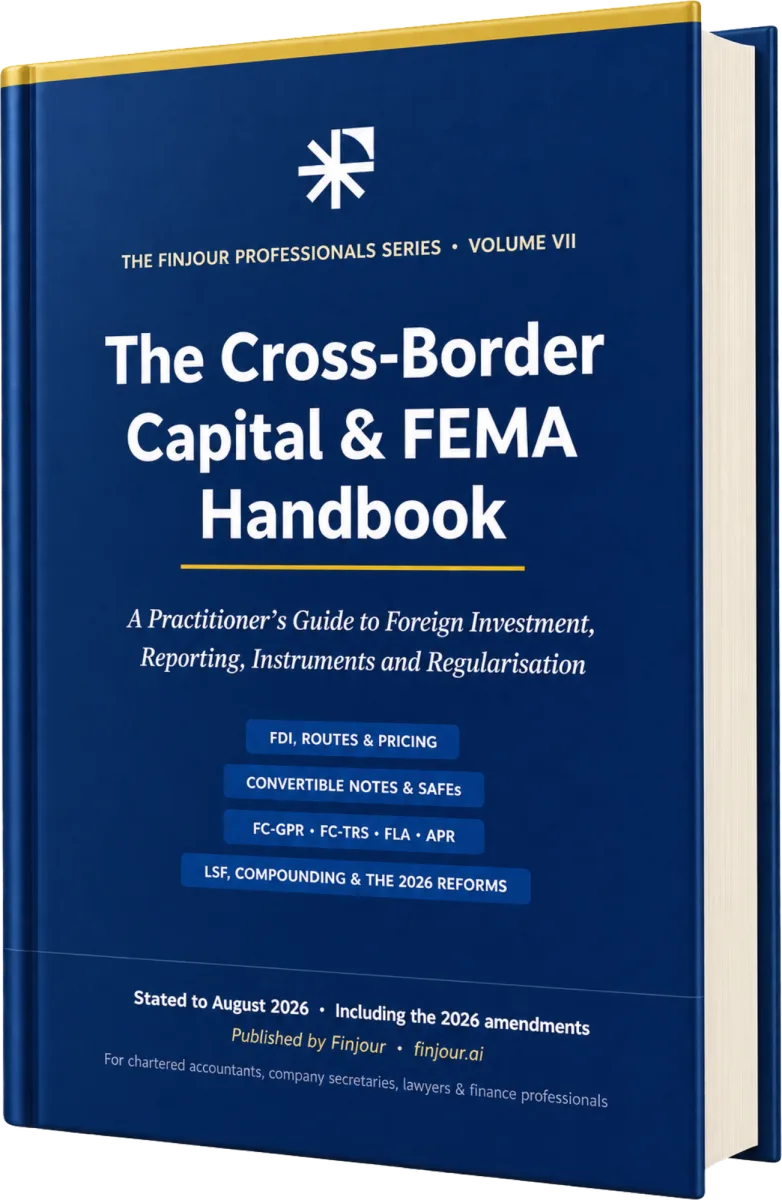
The working handbook for the Chartered Accountants, Company Secretaries, and lawyers whose clients take foreign investment, hold overseas subsidiaries, or borrow from abroad. Filing with the MCA does not satisfy FEMA: two regulators, two portals, two deadlines, and no traffic between them. Get it wrong and the penalty runs to three times the amount involved, plus ₹5,000 for every day it continues, and it lands on the directors personally. This is the book that makes the cross-border file defensible, and Part VII turns the knowledge into a practice.
From the team behind 500+ Indian startup incorporations since 2015. India took in $94.84 billion of gross foreign direct investment in FY 2025-26 and sent $33.29 billion out. Every rupee of it carried a pricing, reporting, or certification requirement that somebody had to discharge. This is the handbook for the practitioner who wants that work, and wants it done right.
What You'll Learn
“A client took a SAFE from a US accelerator and I could not give a straight answer on how to treat it. This book gave me one, and the reasoning behind it, in about twenty minutes. I have since gone back through every foreign-funded client file we have and found two that needed fixing, one of them close to the three-year line. The pricing chapter was an unexpected bonus. I had been quoting these filings as a single low number for years.”
CA Nikhil M · Bengaluru
Verified purchase
Take a Sneak Peek
The four things a cross-border file has to get right
Exchange-control work looks like a filing problem and is really a classification problem. The money comes in under a route and an instrument, and how it is classified decides the pricing rule, the form, and the deadline. Get that wrong at the start and every filing after it is wrong too. This book is organised around the four stages a practitioner actually moves through.
01
The framework, and why it catches people out.
FEMA in a practitioner's working life, the four-document architecture that sits behind every transaction, and the cost of getting it wrong: penalties of up to three times the amount involved, up to ₹2 lakh where the amount is not quantifiable, and ₹5,000 for every day a contravention continues, reaching the directors personally. Covered in Part I.
02
Money in, and the instruments startups actually use.
Routes, caps and entry, the land-border regime, instrument classification, and the pricing provision in Rule 21, which sets a floor on the way in and a ceiling on the way out. Then the startup instruments in their own right: convertible notes and the DPIIT-recognition condition, SAFEs and the borrowing trap, ESOPs, sweat equity and buy-backs, and downstream investment. Covered in Parts II and III.
03
Money out, and the reporting machine.
The line between outbound direct investment and portfolio investment, flips, SPVs and the two-layer rule, and external commercial borrowings, with the borrowing return now event-based from February 2026 rather than monthly. Then the portals, FC-GPR and FC-TRS, the perpetual annual returns, and why filings get rejected. Covered in Parts IV and V.
04
When it goes wrong, and building the practice.
The late-submission fee, the three-year cliff beyond which only compounding remains, and what is coming next. Then the part no other volume has: the market for this work sized from official flow data, where the work comes from, how to price it head by head against the ICAI recommended scale, and how to build and scale the practice. Covered in Parts VI and VII.
The recurring base is worth more than the annual flow. The return on foreign liabilities and assets is a perpetual obligation for any entity that has ever received foreign investment, and it does not stop when the investor exits. The outbound annual report continues for as long as an overseas holding is held, including a dormant one. Cumulative inflows of roughly $1.16 trillion since 2000 sit behind a very large population of entities carrying permanent annual obligations.
Signs a client's cross-border file is not defensible
From a file nobody wants to open to a diligence asset
The exchange-control file is either a liability that surfaces under deal pressure or an asset that a client can hand to a diligence team with confidence. That framing sells the engagement far better than the threat of a penalty does, and it is the difference between a one-off clean-up and a relationship with a recurring annual base.
Advising on foreign money without the map
Advising with the cross-border handbook
What this work is actually worth
Drawn from Chapter 23, which prices the work head by head against the Institute of Chartered Accountants of India's Revised Minimum Recommended Scale of Fees. The scale recommends separate figures for Class A, Class B, and Class C cities, so each range below runs from the Class C figure to the Class A figure. Note what the scale does not do: it leaves substantive advisory work, structuring, collaborations, and cross-border tax, deliberately open, because it cannot sensibly be reduced to a fixed figure. That is the shape your own pricing should follow.
A single transaction usually draws on three heads at once, which is why the book quotes it in layers rather than as one number: on the Class A scale, certification at ₹15,000, the Reserve Bank filing at ₹35,000, and the structuring advice on the special-assignment day rate at ₹35,000. The handbook is ₹1,999. One reporting engagement covers it many times over, and the annual returns behind it recur for as long as the client holds the position.
4.8 / 5(6 reviews)
Rated by Indian CA / CS practitioners
“The decision tree for late fee versus compounding is the clearest thing I have seen on this. Used it on a client file the same week I bought it.”
CS Priya N · Hyderabad
Verified purchase
“Practical, current, and specific about fees, which is rare. The ninety-day plan at the end is genuinely usable.”
CA Sandeep V · Indore
Verified purchase
“Very good on the instruments and the reporting. I would have liked more worked examples on the outbound side, but the inbound coverage is thorough.”
Rahul T · Mumbai
Verified purchase
Built on real engagements
The team behind Finjour has been incorporating and advising Indian startups since 2015, with 500+ to date, and 100+ of them going on to raise ₹100 crore+ in angel, VC, or debt funding. We have taken in the foreign cheques, argued the instrument classification, run the pricing certificates, filed the returns, and cleaned up the files that were never filed at all. That is why this book is specific about where the work sits and what it is worth.
Every rule in it is grounded in the exchange-control framework itself, the NDI Rules and the pricing provision in Rule 21, the outbound and borrowing regimes, and the reporting obligations as they actually stand, with the February 2026 move to event-based borrowing returns reflected rather than the monthly filing most guidance still describes.
The fee guidance is not invented. It is drawn head by head from the Institute of Chartered Accountants of India's Revised Minimum Recommended Scale of Fees, so a quotation can be assembled and defended rather than guessed at.
10+
Years operating
since 2015
500+
Indian startups
incorporated
100+
Funded rounds
angel · VC · debt
₹100Cr+
Capital raised
by startups we advised
SectorsSaaS · fintech · D2C · deeptech · manufacturing · services · GCCs · overseas holding structures
The mistakes that turn a filing into a personal liability
Cross-border work is high-value and high-exposure in equal measure, and the exposure reaches the directors personally. These are the errors that show up most often, and where the book addresses each.
Assuming the MCA filing satisfied the exchange-control obligation
Two regulators, two portals, two deadlines: run the four-document architecture on every transaction
Treating a SAFE as equity or as a convertible note
It is usually neither, and the borrowing framework is the residual home
Issuing a convertible note from a company that is not DPIIT-recognised
Recognition must be in place at issue, with a minimum of ₹25 lakh in a single tranche
Running the borrowing return as a monthly filing
It became event-based from February 2026: filing monthly produces unnecessary filings or missed ones
Stopping the annual return when the foreign investor exits
Both annual returns are perpetual, and a dormant overseas entity still reports every 31 December
Letting a discovered default drift past three years
Under three years there is a formula fee; beyond it only compounding remains, and the cliff does not move

$94.84 bn
gross foreign direct investment into India in FY 2025-26, up from $80.61 billion
3×
the amount involved, the ceiling on a FEMA penalty, plus ₹5,000 for every day it continues
31 Dec
the annual deadline for the outbound report, which runs even for a dormant overseas entity
3 years
the cliff: past it, the formula fee is gone and only compounding remains
“The late-fee and compounding section paid for the book on the first client file I reviewed. We were four months from the cliff.”
— CS Priya N · Hyderabad
What You'll Walk Away With
Classify any foreign instrument with confidence
Equity, convertible note, SAFE, or borrowing. The classification decides the pricing rule, the form, and the deadline, so getting it right at the start is what makes every filing after it correct. This is the judgement clients cannot get from a free article.
Keep the annual returns from lapsing
Both annual returns are perpetual. One does not stop when the foreign investor exits, the other continues while an overseas holding is held even if the entity is dormant. Knowing that turns a forgotten obligation into a recurring engagement.
Handle a discovered default before the cliff
Under three years there is a formula fee with a worked calculation you can run in front of a client. Beyond three years the only route left is compounding, and the cliff does not move. Knowing which side a file sits on changes the advice completely.
Price the work properly
Head by head against the ICAI recommended scale, across all three city classes, quoted in layers rather than as one number, with the substantive advisory work left open the way the scale itself leaves it open.
Launch the practice in ninety days
Part VII sizes the market from official data, shows where the work comes from, and closes with a ninety-day plan in which nothing in the first six weeks requires a single new client. The practice starts inside the client base you already have.
“The pricing chapter is the part I did not expect. I had been undercharging for filings for years.”
— CA Sandeep V · Indore

24 Chapters of Actionable Content
76 pages of structured, India-specific reference material.
Where exchange control actually shows up in practice, why the consequences surface years later in a diligence pack, and why the file is worth maintaining before anyone asks for it.
“Bought it for the SAFE chapter and stayed for the rest. Finally have a clear answer for founders instead of hedging.”
— CA Nikhil M · Bengaluru
A liability in the file vs a diligence asset
Common Questions
No. It is a working handbook for practitioners: how to classify an instrument, run the pricing certificate, get the filing through, keep the annual returns alive, and handle a default that has already happened. It is not a substitute for the bare Act, the NDI Rules, and the current master directions, and it is honest about where specialist counsel or the authorised dealer bank should be brought in.
Foreign money is already in your clients' files. Make it defensible.
Join the practitioners who can classify any foreign instrument, keep the perpetual returns alive, place a discovered default on the right side of the three-year cliff, and price the work properly against the recommended scale.