From generalist services to specialised startup advisory
From entity structuring to IPO readiness, built for the practice area that's now the highest-growth opportunity available to an Indian Chartered Accountant or Company Secretary.
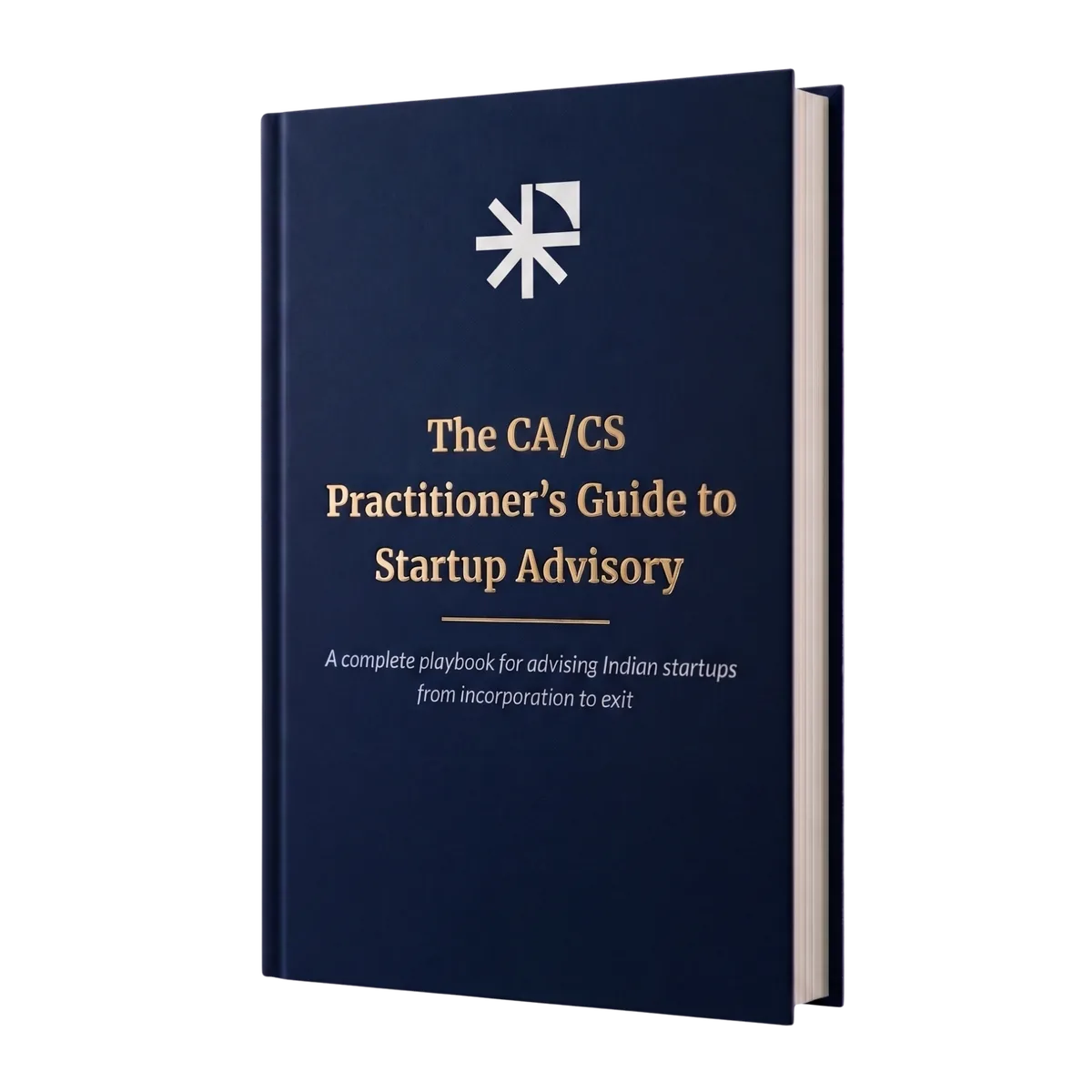
From the team behind 500+ Indian startup incorporations since 2015. 100+ of those companies have raised ₹100+ crore in angel, VC, and debt funding. Every recommendation in this book is grounded in the relevant statute, rule, or circular; every process recommended is one we have seen tested in real engagements.
What You'll Learn
“Most of us trained on mid-corporate work and learned startups on the job, often at the client's expense. This book is what I wish someone had handed me five years ago. It's not a textbook. It reads like a senior partner walking you through what they actually do.”
CA Deepak Bhasi
Startup Advisor & Fundraising Specialist
Take a Sneak Peek
Why startup advisory is structurally underserved, and why that's the opportunity
01
Training pipelines lag the market.
ICAI and ICSI have only recently added structured content on ESOP taxation, SAFE notes, convertible instruments, and Rule 11UA mechanics for unlisted private companies. Most practitioners learned them, if at all, on the job.
02
Documentation conventions are foreign.
A Series-A Shareholders' Agreement looks nothing like a standard JV agreement. A SAFE looks nothing like a debenture trust deed. A Vesting Schedule attached to a Founders' Agreement is closer to a trust arrangement than to anything most generalists have drafted before. Generic templates produce documents that protect the wrong party, miss material clauses, or trigger unintended tax events.
03
The regulatory landscape moves quickly.
Practitioners who do not track changes weekly cannot advise startups credibly. The pace of change has outstripped any annual update.
04
The client expects a different working pattern.
A founder client expects email response measured in hours not days; advice over WhatsApp or Slack rather than letters; cloud-based document tools rather than couriered hard copies; and pricing that is transparent and either flat-fee or retainer-based, not hourly.
1.6 lakh+ DPIIT-recognised startups in India. Indian startups raised between USD 9–12 billion every year between FY 2023-26, across 900–1,500 disclosed deals annually. Each funded round triggers a structured set of professional engagements, and there aren't enough trained advisors to service them.
Common signs you're feeling the gap
What Separates a Generalist From a Startup Specialist
A Series A round generates ₹6–18 lakh in professional fees across legal, tax, and secretarial. ₹2–6 lakh of that is captured by the CA / CS team, if they've earned the right to scope the work.

Without This Reference
With This Reference
The math, before you even read the book
You charge by the engagement, the deliverable, or the retainer. From the book's 2025–26 fee benchmark table (Figure 15.1), here is what the work is worth in a mid-tier Indian practice:
This reference pays itself back the first time you scope a startup engagement confidently instead of under-quoting it or referring it out.
4.8 / 5(100 reviews)
Rated by Indian CA / CS practitioners
“Solid India-specific reference for startup work. I keep coming back to it.”
CS Meera Krishnan
Independent practice · Chennai
“Useful onboarding material for our junior associates. Been recommending it across the team.”
Vivek Bhatia
Senior Associate, Tier-1 law firm · Mumbai
“Wish this had existed five years ago. Has become my default desk reference for startup clients.”
CA Rohit Banerjee
Practice partner · Kolkata
“Solid reference. The FEMA filing flow charts saved me on my last FC-GPR filing.”
CS Pranav Joshi
Independent practice · Pune
“Genuinely useful. The most India-specific reference of its kind I've come across.”
Aarti Subramanian
Tax counsel · Bengaluru
“Decent reference. Some chapters are basic for our team but a few are excellent. Recommended.”
CA Devika Menon
Senior Manager, Big-4 · Mumbai
“Doing my second reading. Find something new each time. Highly recommended for anyone advising Indian startups.”
CS Karthik Rao
Independent practice · Hyderabad
“Used the engagement letter and scope-of-work templates verbatim for two new startup clients last month. Worth the price.”
CA Saurabh Agrawal
Partner, boutique firm · Delhi
“wasn't sure if it'd be useful for a CMA but ended up recommending it to a few colleagues. solid book.”
Ritu Sahay
CMA, independent practice · Ahmedabad
“Solid practitioner-side resource. India-specific in a way most global references aren't.”
Aman Khanna
Counsel, corporate law · Mumbai
Built on real engagements
The team behind Finjour has been incorporating and advising Indian startups since 2015, 500+ to date, with 100+ of them going on to raise ₹100 crore+ in angel, VC, or debt funding. We've drafted the Founders' Agreements, run the Rule 11UA valuations, structured the SAFEs, signed off on FC-GPRs, and delivered the data-room artefacts that close those rounds.
Every opinion in this book is grounded in the relevant statute, rule, or circular. Every process recommended is one we've seen tested in a live engagement, not hypothetical, not borrowed from a US textbook, not generated by AI.
The CA / CS practitioners we work alongside told us, repeatedly, what they wished existed. This is that book.
10+
Years operating
since 2015
500+
Indian startups
incorporated
100+
Funded rounds
angel · VC · debt
₹100Cr+
Capital raised
by startups we advised
SectorsSaaS · D2C · fintech · AI/ML · marketplaces · edtech
The Engagement Risks This Book Helps You Eliminate
Each chapter solves a specific risk that costs practitioners time, fees, or clients
Using a generic JV template to draft an SHA, protecting the wrong party
Every Indian SHA / SSA clause explained, with negotiation levers
Filing FC-GPR or FC-TRS late because timelines aren't engagement-tracked
Full FEMA, ROC, GST, TDS, DPDP compliance grid with calendars
Producing a Rule 11UA valuation that fails investor diligence
The Rule 11UA methods and post-2023 amendments, and how to make the valuation defensible
Misclassifying a SAFE or convertible in the books, triggering tax exposure
Treatment of SAFE / CCPS / CCDs / OCDs across accounting, tax, and CS
Pricing on hourly rates that startup founders push back on every quarter
The three pricing models (fixed-fee, retainer, hourly) and the engagement-letter anatomy

17
Chapters Across 7 Parts
105
Pages of Practitioner Reference
100+
Checklist Items Across the Book
7
Lifecycle Stages in the Checklist Library
“The five DD red flags from Chapter 10 are now on the wall in our office. I've already caught two missed FC-GPRs in clients I inherited last quarter. The Master Checklist Library in Appendix C is laminated, every partner in my firm has a copy.”
— CA Deepak Bhasi · Startup Advisor & Fundraising Specialist
What You'll Walk Away With
Statute & Rule Reference Index
Every Companies Act section, FEMA rule, Income Tax provision, and SEBI regulation cited in the book, indexed by subject for fast desk-reference lookup (Appendix A).
Master Checklist Library
Every chapter's Practitioner's Checklist consolidated into a 7-stage library, run it at the start of each engagement and again before you sign (Appendix C).
The Template-Library Blueprint
Chapter 17 specifies the 12 core templates a practice should build. Founders' Agreement, ESOP plan, cap-table master, engagement letters, board-resolution library, with what each must contain.
Rule 11UA, Explained
How the NAV and DCF methods work, the post-2023 amendments, and what makes a valuation defensible at investor diligence (Ch 6).
The FEMA Compliance Architecture
FC-GPR, FC-TRS, FLA, and ODI: what each filing is, the timelines that matter, and where generalist advisors slip (Ch 5).
Glossary of Startup Terms
SAFE, CCPS, ROFR, drag-along, liquidation waterfall, anti-dilution, IFC and more, explained for a generalist practitioner (Appendix B).
“Chapter 6 on funding instruments is the one I keep going back to. The way the Rule 11UA valuation methods are mapped against the FEMA pricing workflow, and the practical reality that the Section 56(2)(viib) abolition does not remove the need for the valuation report, is exactly the level of clarity my practice was missing.”
— CA Deepak Bhasi · Startup Advisor & Fundraising Specialist

17 Chapters of Actionable Content
105 pages of structured, India-specific reference material.
The arithmetic of the opportunity, 1.6 lakh+ DPIIT startups, USD 9–12 bn raised every year, and a Series A round generating ₹6–18 lakh in professional fees. Why the four structural gaps in training, documentation, regulatory tracking, and working style are the basis of a defensible practice.
“Chapter 8 on cap tables is the one I keep going back to. The pre-money / post-money worked example with the ESOP top-up dilution math is the exact conversation I have with founders before every Series A. Now I have a book reference I can hand them so we spend the meeting deciding, not explaining.”
— CA Deepak Bhasi · Startup Advisor & Fundraising Specialist
This book vs ICAI / ICSI material

The complete reference — ₹1999
Everything in one download. One-time payment, lifetime access.
Today, as one bundle
One-time payment. Indian payment methods accepted (UPI, cards, wallets, net banking).
- Instant download: PDF with the checklist library, statute index, and glossary inside
- One-time payment · UPI, cards, wallets, net banking
Common Questions
All three. The book is written for any professional who advises Indian startups. Chartered Accountants, Company Secretaries, Cost & Management Accountants, and lawyers. Some chapters lean more towards one discipline (e.g. Chapter 11 on statutory audits is CA-heavy, Chapter 5 on the compliance architecture is CS-heavy), but every chapter is built for a multi-disciplinary advisory team.
Become the go-to advisor for Indian startups.
Join the practitioners who've stopped treating startup engagements as one-off side work, and started building defensible advisory practices around them.