From trusting the term sheet to modelling it
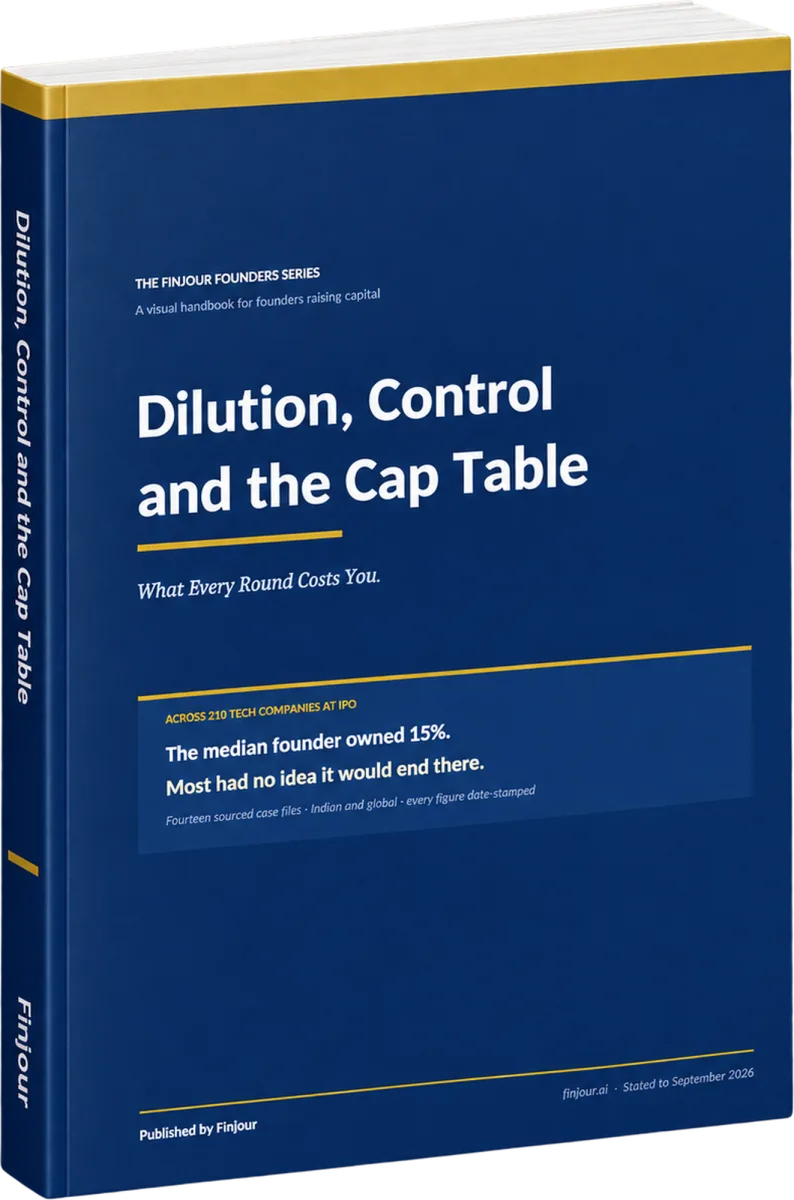
What every round costs you. Across 210 technology companies at listing the median founder owned 15%, and most had no idea it would end there.
Volume IV of the Finjour Founders Series. Stated to September 2026.
What You'll Learn
Take a Sneak Peek
The four things that decide what you are left holding
Ownership does not fall in one dramatic moment. It falls in four or five decisions that each felt reasonable at the time, and the book is organised around the four places those decisions get made.
01
What you actually own, and how to read it.
How to read a cap table, the three ways ownership falls, and why dilution on its own is not the enemy. A smaller share of a much larger company is the point of raising at all. Covered in Part 1.
02
The arithmetic of a single round.
Whether a valuation is pre-money or post-money, where the option pool sits, what an outstanding convertible or SAFE does when it converts, and what four rounds forward actually looks like when you model it rather than assume it. Covered in Part 2.
03
The clauses that decide what an exit pays.
Liquidation preference, participation and the double dip, anti-dilution protection, and pay-to-play, drag and tag. These do not touch the headline valuation and they change the outcome by crores. Covered in Part 3.
04
Control, which is a separate question.
The board is the company. Protective provisions, board composition and dual-class structures decide what you can still do at 20% ownership, and what you cannot do at 60%. Covered in Part 4, then tested against fourteen case files in Part 5. Covered in Parts 4 to 6.
One illustrative model runs through Part 3. An investor puts in ₹20 crore for 20%. Above a ₹100 crore exit the preference is irrelevant and they simply take their 20%. Below it the preference bites, and at a ₹15 crore exit the founders receive nothing at all. Make the preference participating and the same investor takes ₹36 crore on a ₹100 crore exit rather than ₹20 crore.
Signs you are about to sign something you have not modelled
From negotiating the valuation to negotiating the terms underneath it
Founders negotiate hard on the number they understand and accept the clauses underneath it. Nobody is hiding anything: a term sheet is short and every term in it is standard. The arithmetic is simply invisible until someone models it, and modelling it is a skill rather than a talent.
Signing on trust
Signing having modelled it
What a clause actually costs
These are illustrative models from the book, not quotes from any real term sheet, and the book says so each time. They exist to show that the expensive decisions are the ones that never touch the headline valuation.
None of those five lines changes the valuation anyone announces. The handbook is ₹1,299. Catching a single one of them before you sign is worth more than every book Finjour has published put together.
Rated by founders, professionals and students
Why this handbook exists
Finjour has incorporated and advised 500+ Indian startups since 2015, and sat on the founder's side of more than a hundred funded rounds. The pattern is consistent: founders negotiate hard on valuation, which is the number they understand, and accept the clauses underneath it, which are the ones that decide what a round actually costs.
Nobody is hiding anything. A term sheet is a short document and every term in it is standard. The problem is that the arithmetic is invisible until someone models it, and by then the round is signed. A preference stack, an option pool placed before the money rather than after, or a full-ratchet anti-dilution clause each change the outcome by crores without changing the headline valuation at all.
So this book prices the clauses instead of describing them. Every worked example is illustrative and says so, every case file is dated and sourced, and the closing checklist exists to be read before the term sheet arrives rather than after it is signed.
15%
Median founder stake
at IPO, across 210 companies
14
Case files
six global, eight Indian
21
Chapters
across six parts
Sectorspre-seed · seed · Series A · bridge rounds · secondaries · ESOP pools
The decisions that cost the most and look the smallest
None of these is a trap and none of them is hidden. They are standard terms whose arithmetic is invisible until it is modelled, and the book prices each one.
Not confirming whether the valuation is pre-money or post-money
The same sentence gives the investor 20% or 25%: get the basis in writing before anything else
Letting the option pool sit before the money
A 10% pool on a ₹20 crore pre-money makes the real valuation ₹17.5 crore, funded by you alone
Accepting a participating preference as standard
On a ₹100 crore exit that is ₹36 crore to the investor rather than ₹20 crore
Never calculating the preference crossover number
Below it the preference decides the outcome, and at a low enough exit the founders get nothing
Agreeing full-ratchet anti-dilution
Weighted average moves a ₹100 conversion price to ₹95.45, a full ratchet moves it to ₹50
Treating ownership and control as the same question
The board is the company: protective provisions decide what you can still do at any percentage

15%
the median founder stake at IPO across 210 technology companies
14
sourced case files, six global and eight Indian, every figure dated
20% or 25%
what one unexamined word about the valuation is worth to an investor
₹36 cr vs ₹20 cr
what a participating preference pays on the same ₹100 crore exit
What You'll Walk Away With
Read a term sheet for what it pays, not what it says
The book's own test question, which it repeats twice because it is the fastest way to cut through a term sheet: on a ₹100 crore exit, what does this pay you and what does it pay me? Any investor can answer it, and the answer tells you more than the valuation does.
Catch the pre-money ambiguity before you agree to it
One unexamined word moves an investor's stake from 20% to 25% on the same sentence. You will know to confirm it in writing, and what to say when the answer is post-money.
Know who is paying for the option pool
A pool placed before the money is funded entirely by the founders and quietly reduces the real valuation. You will be able to say so, in the room, with the arithmetic.
Price the clauses instead of accepting them
Liquidation preference, participation and anti-dilution each change what an exit pays without touching the headline number. The book models all three so you can negotiate the ones that matter and concede the ones that do not.
Separate control from ownership
The board is the company. You will understand why a founder at 20% can still run it and a founder at 60% can be unable to act, and which levers are worth asking for.

21 Chapters of Actionable Content
57 pages of structured, India-specific reference material.
Where founders actually land. Across a published study of 210 technology companies at listing the median founder or chief executive owned 15%, and the average was 20%. The range is very wide, from 43% down to under 5%, and where you land is the sum of how much you raised, how early, and at what price.
Reading a term sheet vs modelling one
The complete handbook — ₹1299
Everything in one download. One-time payment, lifetime access.
Today, as one download
One-time payment. Indian payment methods accepted (UPI, cards, net banking).
- Instant download: one PDF with all four toolkit templates inside
Common Questions
It is the right time, and the book says so in its first chapter: it is worth seeing the arithmetic before the first term sheet rather than after the fourth. Almost everything in it is more useful before you are negotiating than during. The closing checklist is explicitly written to be read before a term sheet arrives.
Read it before the term sheet arrives, not after it is signed.
Twenty-one chapters, fourteen sourced case files, the cap table template, the four-round dilution model, and a one-page checklist written for the week before you sign rather than the month after.
Complete the series
The other titles, and the set that carries all four as one download.