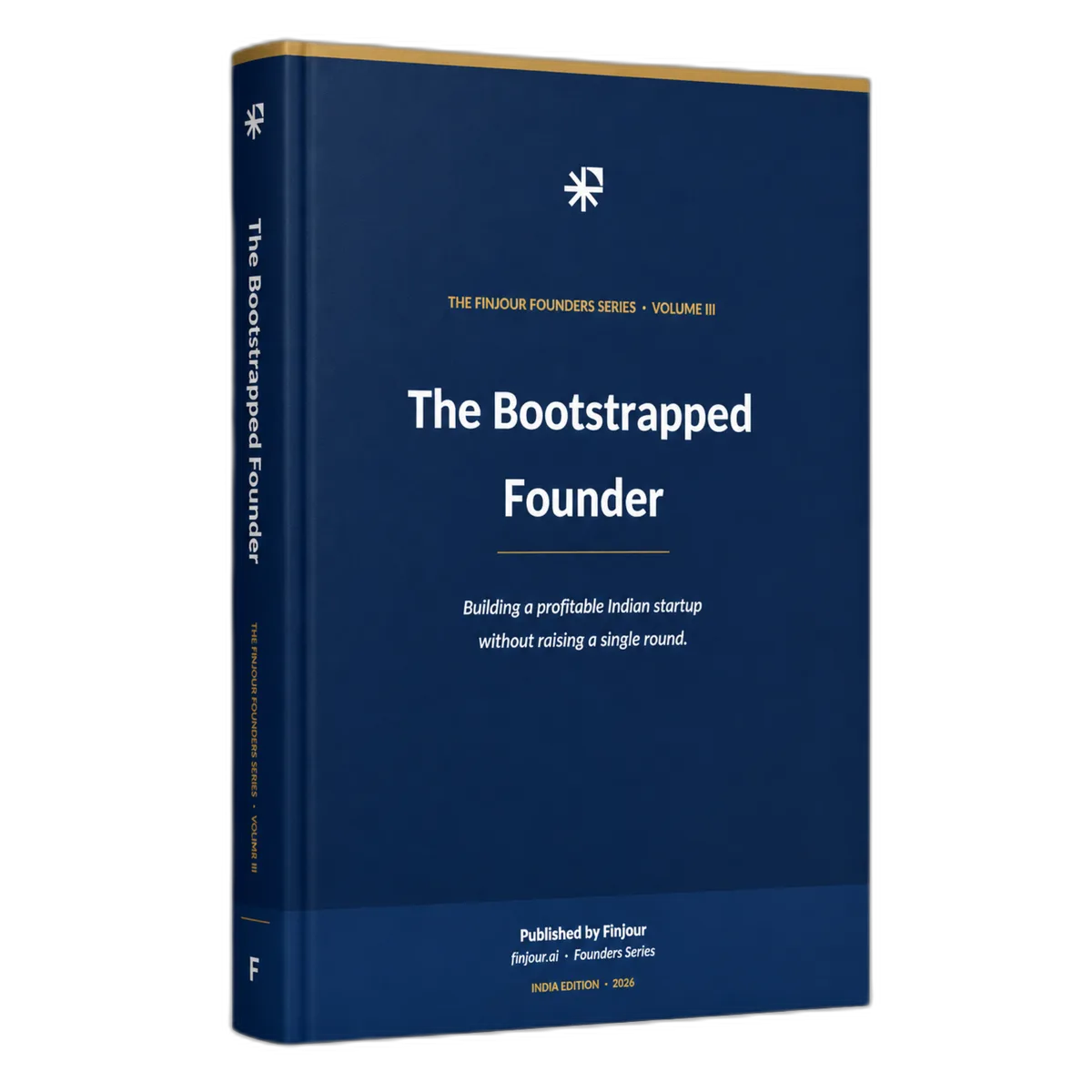
Build a profitable startup without raising a single round
Know your real numbers, follow the systems that keep a self-funded business alive, and sidestep the costly mistakes that quietly kill it. Cash, pricing, unit economics, and a clear profit picture you can read yourself, without a finance team or a CA on retainer. The operating manual for the 99.95% of Indian founders the startup world overlooks.
From the team behind 500+ Indian startup incorporations since 2015. Volume III is the playbook for the 99.95% of founders who build on their own revenue, not a venture cheque.
What You'll Learn
“I was running a business that looked profitable and I had no real idea of my own numbers. This book made me sit down and actually work out my gross margin, my runway, and the price I should have been charging all along. Within two months I had raised prices, cut a cost that was quietly bleeding me, and for the first time I knew exactly how much profit the business really makes. It is the financial clarity I would have paid a CFO for.”
Karthik Rajan
Founder, B2B services firm, Coimbatore
Take a Sneak Peek
You're not failing. You were never handed the playbook.
The entire startup conversation, the press, the accelerators, the funding announcements, is about the founders who raise. Build on your own revenue and you are the overwhelming majority, yet almost none of it is written for you, and most of it leaves you feeling alone. You have the passion and the product. What no one hands you are the fundamentals that quietly decide whether the business survives or dies: cash discipline, pricing, unit economics, and the patience to grow at the pace your own money allows.
01
The press only covers the funded
Success is implicitly defined as the next round. A founder running a perfectly good, profitable business is made to feel they are doing something wrong, that real founders raise. It is one of the most damaging ideas in Indian entrepreneurship.
02
The playbooks assume a budget you don't have
Hire ahead of revenue, spend on paid acquisition, scale fast. Followed on a fraction of the budget, the funded playbook simply runs a bootstrapper out of cash faster. The earned, compounding path is barely written down.
03
The mentorship desert is real
The funded founder has investors, a board, and a peer group. The bootstrapper often has no board to report to, no investor to call, and few peers walking the same path. India's shortage of real mentorship makes it worse.
04
The India specifics are missing
GST, TDS, ROC, the nil-return trap, the Income Tax Act 2025, the DPDP regime: the compliance a solo founder cannot ignore is exactly what borrowed Silicon Valley advice never mentions.
You are not on the margins of the startup story. You are its largest, most resilient, and most overlooked chapter.
— Preface
Only ~0.05% of startups ever raise venture capital. The other 99.95% build on their own money, and almost nothing is written for them.
You feel it as:
From feeling left out to building something that lasts
The bootstrapped path is not the consolation prize. For the founders who walk it well, it is the more powerful one: the company is entirely yours, no investor decides your fate, and you keep what you build. What separates the businesses that thrive from the ones that quietly die is not luck or passion. It is a handful of fundamentals, cash, pricing, unit economics, the funding decision, and every one of them can be learned.
Building without a plan
Building with the bootstrapper's method
What one wrong bootstrapped decision costs
A bootstrapper has no investor cash to absorb a mistake. A single avoidable error, a premature hire, a mispriced product, a missed filing, can cost more than this book many times over. The book exists to help you avoid the expensive ones.
Avoid one of these and the ₹999 you spend here returns itself a hundred times over. That is the whole case for reading before you decide.
4.9 / 5(57 reviews)
Rated by founders, professionals and students
“The unit-economics chapter made me calculate my real CAC and payback for the first time. I had been spending to grow a product that lost money on every customer. I fixed the pricing and the math finally works.”

Sneha Menon
Solo founder, SaaS
“I was underpricing out of fear that Indians won't pay. The pricing chapter changed how I think about margin entirely. I raised prices 20 percent with almost no churn, and it went straight to the bottom line.”

Arjun Patel
Founder, D2C brand
“The runway math is the part I keep coming back to. I now know my net burn and exactly how many months I have, and I update it every month. It turned a constant low-grade panic into a plan.”

Rohan Desai
Founder, services agency
“I used to hand my CA a shoebox once a year and hope. Now I keep clean books and actually understand my own profit and compliance. The checklists made it a system instead of guesswork.”
Imran Shaikh
Founder, small manufacturing
“The break-even chapter gave me one number to aim at: how many customers a month to cover everything. That single target changed every decision I make about spending and hiring.”
Priya Nair
Founder, edtech
Why this guide exists
This guide isn't written by a 'guru.' It's the distilled playbook of the Finjour team, who have spent the last decade building and advising Indian companies, since 2015.
Over the last 10 years, we've helped incorporate 500+ Indian startups. We've watched what actually keeps a company alive when there is no next cheque coming, and it is rarely what the funding headlines celebrate. It is cash discipline, unit economics that work at the unit level, pricing that holds a margin, and the patience to grow at the pace your own revenue allows. The frameworks here come from that work, not from consulting decks.
This is the operating manual we wished existed for the founder the startup story usually forgets: the one building a real, profitable business in India without raising a single round. We wrote it for the majority, not the 0.05%.
10+
Years operating
since 2015
500+
Indian startups
incorporated
99.95%
Founders never raise VC
this book is for them
11,000+
Startups shut in 2025
mostly out of cash
Sectorsservices · SaaS · D2C · manufacturing · agencies · regional brands
The mistakes that quietly kill bootstrapped companies
Most bootstrapped businesses do not fail because the idea was wrong. They fail because the founder made an avoidable mistake the funding headlines never warned them about. Here are the most common, and where the book addresses each.
Confusing profit with cash, and running out of money while profitable on paper
The working-capital cycle and the three levers that extend runway without raising
Pricing too low because you believe Indians only buy cheap
Pricing to your margin and tiering customers by willingness to pay, not fear
Scaling on a few good months, then drowning in fixed costs when a slow quarter hits
Constraint-led scaling: let demand pull growth, spend only on what already works
Hiring too early and shortening your own runway
Hiring late against a real bottleneck, and structuring pay you can sustain
Assuming no revenue means no filings, and accruing penalties silently
The nil-return trap, and a compliance calendar you build once and automate
Raising to rescue a struggling business
The honest funding framework, and why capital amplifies whatever is already true

20
chapter checklists to run on your own business
4
worked models: runway, unit economics, break-even, pricing
12-24
months to break-even, not the 5 to 10 years funded firms take
3
Indian giants decoded: Zerodha, Zoho, Wingify
“Most bootstrapped businesses do not fail because the idea was wrong. They fail because the founder ran out of cash, runway, knowledge, or hope before the business found its feet.”
— Chapter 20 · Surviving, and Knowing When to Stop
What You'll Walk Away With
Know your real numbers, instead of guessing at them
₹1500Stop wondering how much profit you actually make. The runway, cash-flow, unit-economics, and break-even math that tells you exactly where you stand, what is working, and how long your money lasts, in plain arithmetic you run yourself without a finance team.
Price for margin in a price-sensitive market
₹1500Reject the myth that you must be the cheapest, price to the gross margin the business needs, and use tiers instead of the discount trap that starves a bootstrapper.
Grow on a near-zero marketing budget
₹1500The four earned channels that cost time not money, how to win your first 100 paying customers by hand, and when to spend versus when to wait.
Build the team and compliance you can afford
₹2000Hire late against real bottlenecks, compete on what money cannot buy, and carry the GST, TDS, ROC, and DPDP obligations a solo founder cannot ignore.
Make the funding decision honestly
₹1500A clear framework for whether you should raise at all, the non-dilutive toolkit, and how to raise from strength if you ever choose to.
“Patience is not the bootstrapper's limitation. It is the bootstrapper's method.”
— Chapter 10 · Constraint-Led Scaling

20 Chapters of Actionable Content
67 pages of structured, India-specific reference material.
The number the ecosystem never mentions, why not raising is a choice of business model rather than a verdict on your worth, and when VC genuinely is the right tool.
“You do not need anyone's cheque to build something that lasts. You need a plan. This is the plan.”
— Preface
Free advice vs the bootstrapper's playbook
A fraction of the alternatives — ₹999
Every answer in this book is available elsewhere: from an advisor, a CA, or your own costly trial and error. Here is roughly what piecing it together that way would cost, and what you pay instead.
This book, today
One-time payment. No subscription. Secure checkout.
- Instant PDF download, yours to keep
- Written for India, current to 2026
- Worked numbers you run on your own business every month
Common Questions
No. It is honest about funding. Venture capital is the right tool for a specific kind of business, and Chapter 17 gives you a clear framework to decide whether yours is one. The point is to choose deliberately rather than to raise by default or to feel like a failure for not raising.
You don't need anyone's cheque to build something that lasts
You are not on the margins, and you are not alone. You have the plan: a complete, practical method for building a profitable Indian business without raising a single round, with the worked numbers, checklists, and India specifics to use it. Now go and build.