You were taught to audit a firm. Nobody taught you to run one.
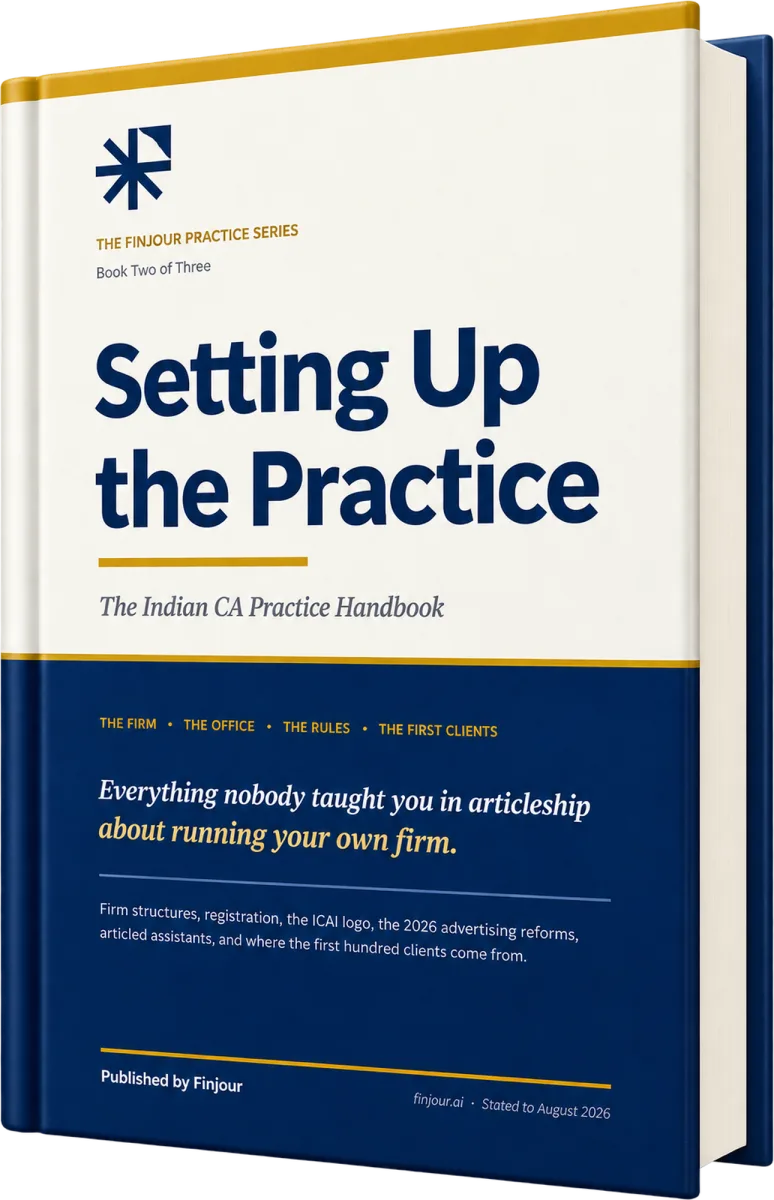
A 93-page induction into everything articleship left out: choosing between sole practice, a partnership, an LLP and a multi-disciplinary partnership, getting the firm name approved, Form 117 and Form 18, what the 1 April 2026 Code of Ethics actually permits you to publish, taking articled assistants properly, and where the first hundred clients come from. Book Two of the Finjour Practice Series.
Book Two of the Finjour Practice Series. Stated to August 2026.
What You'll Learn
“I qualified last year and genuinely did not know where to start. The ninety-day plan gave me an order to do things in, which was the thing I was missing. The structure chapter made me constitute a firm rather than just practise under my number, and I am glad I did that at the start rather than trying to fix it later. The part on what you can and cannot put on a website was the biggest surprise, I had it completely wrong.”
CA Nikhil B · Surat
Verified purchase
Take a Sneak Peek
The four things that quietly set the shape of a practice
None of these decisions feels important at the time. Each one is made once, early, usually on a friend's recommendation, and then lived with for a decade. These are the four the book takes seriously.
01
The structure you picked because someone else picked it
Sole practice, a proprietary firm, a partnership, an LLP, a multi-disciplinary partnership. They differ in what you may offer, what you may sign, what you are exposed to, and how easily the firm can grow. Part II compares all five and Appendix B puts them side by side. Rule 8 is worth reading before you assume MDP solves your problem: multi-disciplinary widens what you may offer, never what you may sign.
02
The name, filed in the wrong order
Firm names go through approval before constitution, and the chain does not run backwards. Chapter 13 covers Form 117 and Form 18 and the rule that matters most: file Form 117 only when you are ready to file Form 18, because the clock starts on approval.
03
Promotion rules you learned before they changed
At its 447th Council meeting in December 2025 the Council approved amendments to the Advertisement and Website Guidelines, effective 1 April 2026 with the thirteenth edition of the Code of Ethics. It is the most significant relaxation of the profession's advertising restrictions in decades. Most practitioners are still operating under the old understanding, and are more restricted than the rules now require.
04
Waiting for clients instead of telling anyone
Part VII is about where the first hundred clients actually come from, and the answer is almost never advertising. Rule 30 is the one most new practitioners skip: tell everyone who knows you that you have started, and what you do. Most never hear it.
Constitute a firm from the beginning. A firm can grow; a name on a membership number cannot.
— Rule 5, Part II
Thirty-two rules, one per chapter, and the first ninety days of a practice mapped week by week in Chapter 4.
This book is for you if any of these are true
From improvising the firm to building it deliberately
Every chapter ends with one rule, and the rules are cumulative. By the end you have a constituted firm, in the right form, registered in the right order, with documents that hold and a plan for where the first clients come from.
Setting up by improvisation
Setting up by method
What the book actually hands you
This is not a fee schedule, and the book quotes none. Book One of the series covers pricing. What this volume gives you is the set of decisions and documents that would otherwise be improvised, each one made once and then lived with for years. These are the concrete artefacts, straight out of the appendices.
Nine appendices in total, including the permitted and prohibited table for promotion and the office setup checklist. Positions stated to August 2026, and worth verifying against the current Code of Ethics before you rely on any of them.
4.8 / 5(7 reviews)
Rated by founders, professionals and students
“I had no idea the advertising rules had changed in April. Redid our website the same month and it is bringing in enquiries now.”
CA Shruti K · Bhopal
Verified purchase
“Been practising six years and still got a lot out of Part II. The exclusions clause point alone has saved me one argument already.”
CA Ajay P · Jodhpur
Verified purchase
“Useful and practical, and the appendices are the best part. Would have liked more on pricing, though I gather that is the other book.”
CA Manoj T · Vijayawada
Verified purchase
Why this handbook exists
Every practitioner who has set up a firm has done it once, learned it the hard way, and never written any of it down. So the next one improvises the same decisions from scratch: the structure, the name, the office, the website, the first assistants. The mistakes are not dramatic and they are not obvious for years, which is exactly why nobody warns you about them.
Finjour has incorporated and advised 500+ Indian companies since 2015 and worked alongside the CA and CS firms that serve them. This book is the induction our own network said they wished someone had handed them in the month they qualified.
32
Rules
one per chapter
93
Pages
9
Appendices
Sectorsnewly qualified · sole practice · proprietary firms · partnerships · LLPs · multi-disciplinary partnerships
The five setup mistakes that take years to show up
Each of these is invisible in year one. All of them are expensive by year five, and most are much harder to unwind than to get right the first time.
Never constituting a firm at all
Constitute from the beginning. A firm can grow and can take partners, staff and a brand. A name on a membership number cannot.
Filing Form 117 before you are ready
The clock starts on approval. File Form 117 only when you are ready to file Form 18 behind it.
Operating under the pre-2026 advertising rules
The thirteenth edition of the Code of Ethics took effect on 1 April 2026 and relaxed the framework substantially. Where a restriction is real the book states it. Where it is folklore, it says so.
An engagement letter with no exclusions clause
List what is excluded. That one clause prevents more disputes than every other clause combined.
Taking too much office space too early
Take less space than your ambition suggests. Fixed cost is what turns into fee panic, and fee panic is what makes you concede on price.

32
Rules, one per chapter
93
Pages
9
Appendices
7
Parts
“Approval first, then constitution, then everything else. The chain does not run backwards.”
— Rule 4, Part I
What You'll Walk Away With
The structure decision, made properly
₹5000All five forms compared on exposure, what you may sign, and how easily the firm can grow, with the comparison table in Appendix B.
The registration sequence
₹3000Form 117 and Form 18 in the right order, with the checklist, so the clock does not start before you are ready.
The promotion rules as they are now
₹6000What the thirteenth edition of the Code of Ethics permits from 1 April 2026, and what the solicitation ban still prohibits.
The documents you would otherwise draft twice
₹7000A model engagement letter with the exclusions clause, model appointment and staff letters, and the articled assistant checklist.
“Year one is measured by what you built, not by what you earned.”
— Rule 32, the last rule in the book

7 Chapters of Actionable Content
93 pages of structured, India-specific reference material.
The decision to practise, what a practice actually is, an honest readiness test, and the first ninety days mapped week by week.
“Start with a runway. A practitioner without reserves prices from fear.”
— Rule 3, Part I
Improvised vs deliberately built
What this costs against what it settles — ₹1999
The handbook is ₹1,999. Set that against one structure decision made badly, and lived with for ten years.
Setting Up the Practice
Instant download. 30 days to download your copy.
- Thirty-two rules, one per chapter, collected on a single reference page
- Instant PDF download, yours to keep, no subscription
- Positions stated to August 2026
Common Questions
No. Parts II and IV in particular are worth reading if your firm was set up years ago. The structure you chose then may no longer be the right one, and the advertising rules you are operating under have almost certainly changed.
You are building an asset, not a job. Judge every early decision by that.
Thirty-two rules, nine appendices, the first ninety days mapped, and the promotion rules restated as they actually stand after 1 April 2026. The induction nobody gave you.
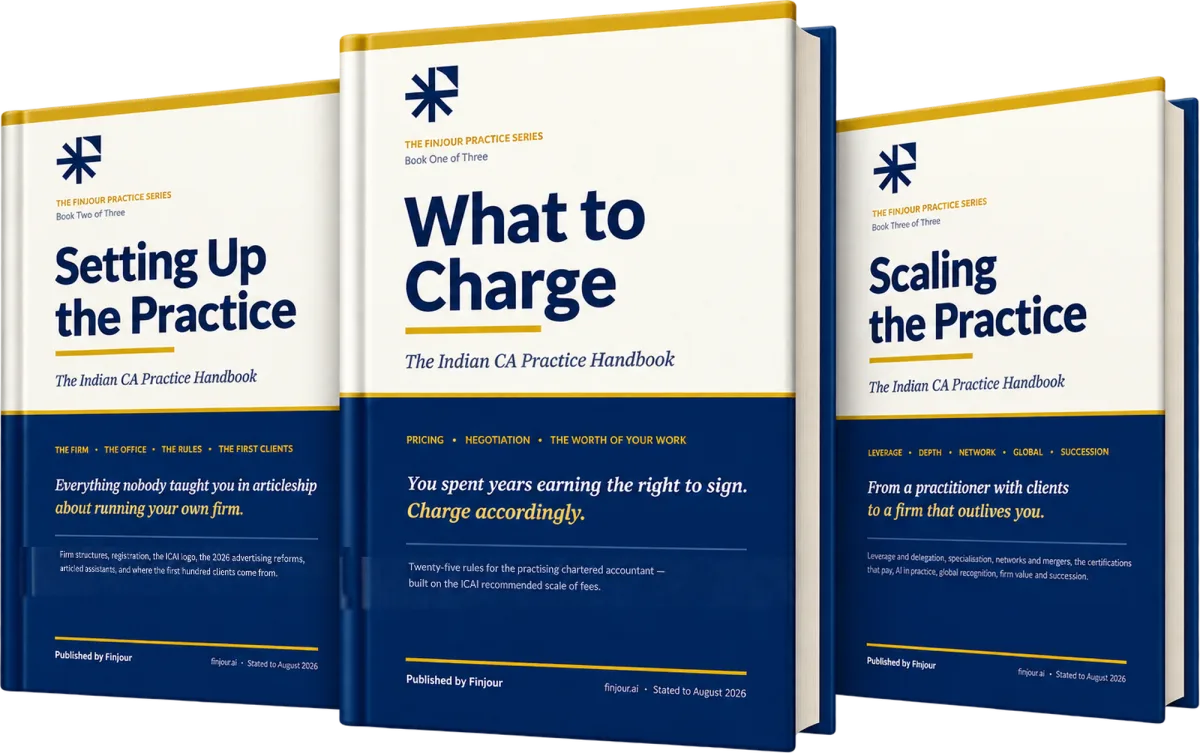
Complete the series
The other volumes, and the set that carries all three as one download.