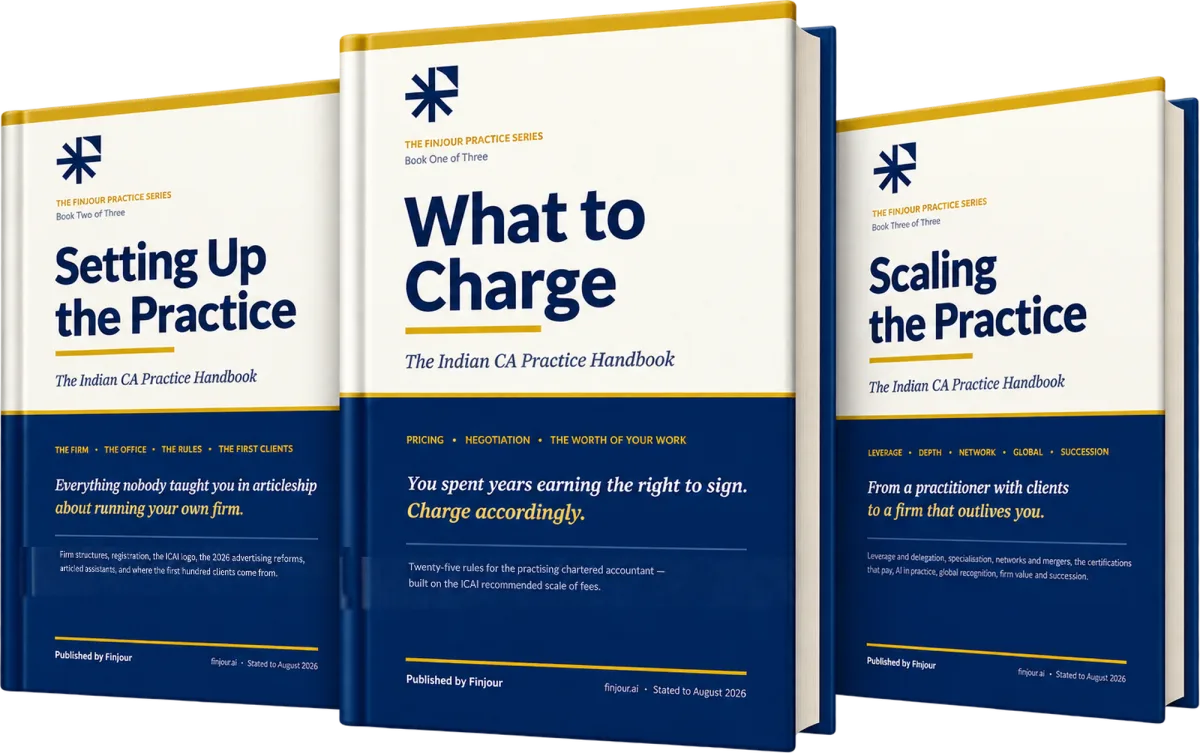
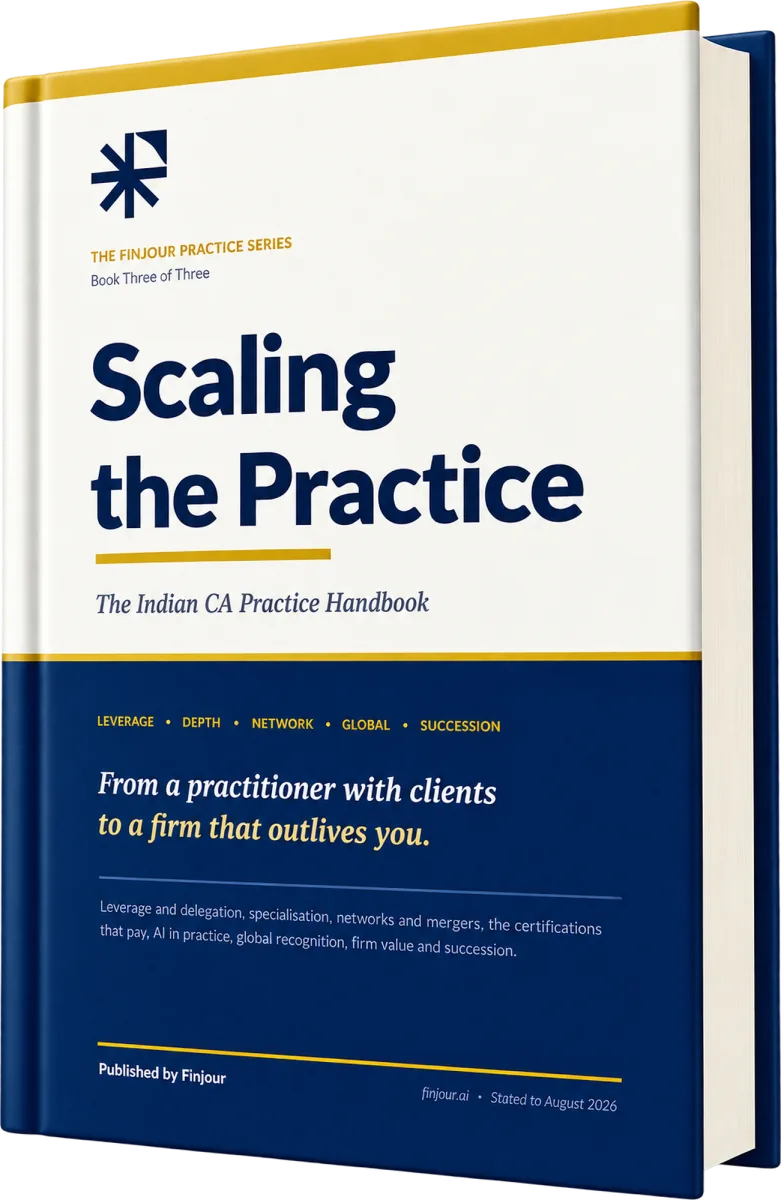
From a practitioner with clients to a firm that outlives you
An 82-page handbook for the practitioner who has hit the only ceiling that ever really binds a professional firm: the number of hours its principal has. Leverage and delegation, specialisation as a pricing strategy, networks and mergers, the certifications that actually pay, the honest place of AI in a practice, global recognition, what the firm is worth, and succession. Book Three of the Finjour Practice Series.
Book Three of the Finjour Practice Series. Stated to August 2026.
What You'll Learn
“Chapter 4 asks you to list everything you did last week and mark what only you could have done. I did it honestly and about a fifth of it qualified. That was the whole book for me, everything after it was just how to fix that. We have since hired an administrator first rather than another qualified person, which is the opposite of what I was about to do.”
CA Girish V · Mysuru
Verified purchase
Take a Sneak Peek
Why working harder stopped working
The ceiling is structural, so the responses that feel like effort all make it worse. More hours, more clients, lower fees to win volume: each of those raises the load on the one resource that cannot be increased. These are the four shifts the book is built on.
01
Everything still runs through you
Only three things genuinely must stay with the principal: acquisition, pricing and review. Everything else is a choice, and most practitioners have never made it deliberately. Chapter 4 diagnoses this by asking you to list last week's work and mark what only you could have done. The answer is usually uncomfortable.
02
You delegate the task and keep the judgement, or the reverse
The line is not instinctive, and instinct puts it in the wrong place. Rule 5 states it: delegate on competence, retain on judgement, and that line is safer and wider than instinct suggests. Chapter 7 then makes the case that review is your primary output, not what happens if there is time left over.
03
You compete on price because nothing distinguishes you
Depth is the only thing that improves all three fee justifications at once. Part III is about specialisation as a pricing strategy, becoming the obvious answer to a narrow question, publishing within the rules, and, hardest of all, choosing what to stop doing. Rule 13: shedding the least valuable third buys the attention that improves the rest.
04
The firm is worth nothing without you in it
You are paid for what transfers. A practice that rests entirely on one person's relationships and judgement has very little value to anyone else, which matters at merger, at retirement, and to everyone who works there. Part VII covers firm valuation, partners and ownership, and succession, with a worksheet and a checklist.
You have scaled when your hours stop being the limit, not when your headcount rises.
— Rule 2, Part I
Scale is not size. A two-partner practice with deep specialisation, excellent systems and no fee pressure is a better outcome than a twenty-person firm competing on price.
You have hit the ceiling if any of these are true
From a practitioner with clients to a firm that outlives you
The ceiling is structural, so the fix is structural. Change what you personally do, deepen what the firm is known for, and build the thing so that it functions without you in it.
Growing by effort
Growing by leverage
What the book actually hands you
This is not a fee schedule, and the book quotes none. Book One of the series covers pricing. What this volume gives you is the set of structural moves that raise the value of your hour instead of adding more of them, each one with a working tool in the appendices.
Eight appendices in total. Rule 28 is the one to act on first: write the succession note this month, because it costs an afternoon and it is owed to others.
4.8 / 5(6 reviews)
Rated by founders, professionals and students
“We were about to merge with another firm. Read the chapter on networks first and did that instead. Still glad we did.”
CA Anupama R · Thane
Verified purchase
“The bit about writing procedures while you do the work rather than as a separate project is obvious in hindsight and I had never done it. We have actual procedures now.”
CA Farhan Q · Hyderabad
Verified purchase
“Solid on leverage and specialisation. The global section was less relevant to me but I can see why it is in there.”
CA Sudhir K · Patna
Verified purchase
Why this handbook exists
The ceiling arrives quietly. Nothing is going wrong, which is exactly what makes it hard to see. The days are full, the clients are fine, the fees are adequate, and the practice has simply stopped growing because the principal has run out of hours. Working harder is the one response that is guaranteed not to help.
Finjour has worked alongside Indian CA firms of every size since 2015, from sole practitioners to multi-partner practices. This volume is about the structural change that separates the two, and it argues for leverage rather than volume throughout.
29
Rules
one per chapter
82
Pages
8
Appendices
Sectorssole practitioners at capacity · two and three partner firms · established practices planning succession
The five mistakes that keep a practice at the ceiling
Each of these looks like progress at the time. That is what makes them hard to spot from the inside.
Hiring before the role exists
Build the role before you hire the person. An undefined role consumes your hours instead of releasing them, which is the opposite of what you hired for.
Treating review as spare-time work
Review is your primary output. It is the mechanism by which work leaves your desk without quality leaving with it.
Writing the procedures manual as a project
Write the procedure while doing the work. Manuals written as projects are never finished, which is why almost no firm has one.
Adding services instead of depth
Depth improves all three fee justifications at once, and nothing else does. Breadth mostly adds ways to be compared on price.
Merging before trying a network
Network before you merge. It buys scale without surrendering your firm, and it is reversible in a way a merger is not.

29
Rules, one per chapter
82
Pages
8
Appendices
7
Parts
“Review is your primary output, not what happens if there is time left.”
— Rule 7, Part II
What You'll Walk Away With
Your hours back
₹9000The leverage audit and the delegation matrix, drawn on competence and judgement rather than instinct, which puts the line in the wrong place.
A reason to be chosen
₹6000Specialisation as a pricing strategy, including the third of your work worth shedding to buy attention for the rest.
Work without solicitation
₹5000The referral engine at scale, and why four maintained relationships outperform fifty collected contacts.
A firm worth something
₹6000The valuation worksheet, what transfers and what does not, and a succession note you can write in an afternoon.
“You are paid for what transfers. Everything resting on you personally is worth little to anyone else.”
— Rule 26, Part VII

7 Chapters of Actionable Content
82 pages of structured, India-specific reference material.
The ceiling you have hit and why effort does not raise it, what scale actually means as against size, leverage versus commoditisation, and the diagnostic that shows how much of last week only you could have done.
“Ask of every growth decision: does this raise or lower the value of my hour?”
— Rule 3, Part I
Growing by effort vs growing by leverage
What this costs against what it settles — ₹2499
The handbook is ₹2,499. Set that against one year spent at the ceiling, doing work someone else in the firm could have done.
Scaling the Practice
Instant download. 30 days to download your copy.
- Twenty-nine rules, one per chapter, collected on a single reference page
- Instant PDF download, yours to keep, no subscription
- Positions stated to August 2026
Common Questions
This volume assumes a constituted firm, priced properly, with systems in place. If fees are still conceded rather than set, start with Book One: no amount of scale corrects a pricing problem, it multiplies it. If the firm itself is not set up properly yet, Book Two covers that.
See the Practice Bundle →Build something that functions without you. That is the whole of it.
Twenty-nine rules, the leverage audit, the delegation matrix, a certification comparison, the recognition arrangements ready reference, a firm valuation worksheet and the succession checklist. The structural change that separates a practitioner with clients from a firm.
Complete the series
The other volumes, and the set that carries all three as one download.