You were taught to audit a firm. Nobody taught you to run one.
The complete Finjour Practice Series, on the firm you run rather than the clients you serve. What to charge and how to hold it, how to set the practice up properly, and how to get past the ceiling of your own hours. All three volumes, one download.

The qualification prepares you superbly for one thing. The technical work.
Articleship teaches you to examine a business, test a control, defend a position. It teaches you almost nothing about the business you will actually spend your career inside, which is your own. So the fee gets set by reflex, the firm gets set up by improvisation, and the ceiling arrives somewhere between the fifth and the tenth year without anyone having warned you it was coming. These three volumes are the part nobody taught.
Charge it. Build it. Scale it.
The three books answer the three questions a practice hits, in the order it hits them. What is my work worth and how do I hold that number. How do I actually build the firm around it. And what do I do when my own hours become the limit. Book Three assumes the first two, and says so on its first page.

What to Charge
Book One is about the pause before you answer the question every client asks, and why the number that comes out is lower than the number in your head. It gives you the floor the Institute recommends, the reasoning to price above it, and the words to hold the line. The number stays yours.
- The ICAI recommended scale as a working table, by class of city
- Where the line on low fees actually falls, including the 2 July 2026 tender decision
- Change the scope instead of the rate, and know exactly what can be removed

Setting Up the Practice
Book Two is the induction nobody gave you. Structure, registration, the office, what the Code of Ethics actually permits you to publish since 1 April 2026, articled assistants, and where the first hundred clients come from. The decisions that get made once and lived with for a decade.
- Sole practice, partnership, LLP and MDP compared on exposure and growth
- Form 117 and Form 18 in the right order, with the registration checklist
- The 2026 advertising reform, stated precisely, folklore separated from rule
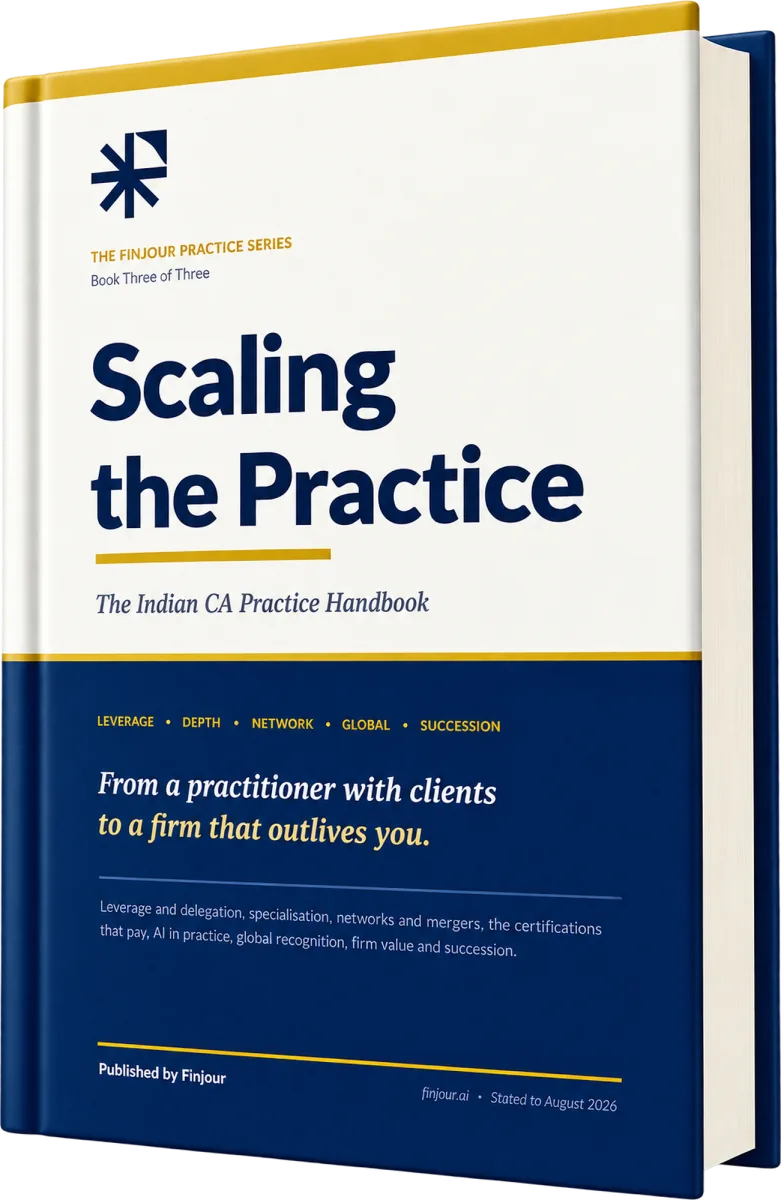
Scaling the Practice
Book Three starts where the practice is full and has stopped growing, because the principal has run out of hours. It is not solved by working longer. It is solved by changing what you personally do, then deepening what the firm is known for, and building something that functions without you.
- The leverage audit and the delegation matrix, drawn on judgement not instinct
- Specialisation as a pricing strategy, and what to stop doing
- What the firm is worth, and the succession note you can write in an afternoon
The practice this series builds
The difference between a practitioner with clients and a firm that outlives you.
The improvised practice
- The fee is set in the pause before you answer, and it always moves downward
- The firm structure was chosen on a recommendation and never revisited
- The website says almost nothing, because nobody was sure what it could say
- Every hour of growth has to come out of your own day
- You are quoted against on price, because nothing obviously distinguishes you
- If you stopped for six months, there would not be much left
The practice built on purpose
- You have a costed floor, an anchor you did not invent, and words for every objection
- The firm is constituted in the right form, registered in the right order
- The site and the content sit confidently inside the reformed 2026 framework
- Only acquisition, pricing and review stay with you, by deliberate choice
- Depth makes you the obvious answer to a narrow question, and price stops being the argument
- The firm functions without you, which is what makes it worth something
What the three volumes give you
All three Practice Series volumes, 257 pages, delivered together as one download
What to Charge: 25 rules on pricing, built on the ICAI recommended scale, with the scale as a working table
Setting Up the Practice: 32 rules on structure, registration, the office, and the 1 April 2026 advertising reform
Scaling the Practice: 29 rules on leverage, depth, networks, capability, going global, and succession
Twenty-five appendices across the set, including a model engagement letter, the quotation builder, the delegation matrix, and the firm valuation worksheet
The objection-response scripts, the registration checklist, the leverage audit, and the succession checklist
Written from a position of respect for the qualification
Chartered accountancy in India is one of the hardest professional qualifications in the world to obtain, and the work it licenses carries a public-interest responsibility that few other professions bear. That is not flattery. It is the premise of the argument these books make. Finjour has worked alongside Indian CA and CS firms since 2015, on the audits, valuations, incorporations and filings that make up ordinary practice, and every position here is stated to August 2026.
Read by practitioners across India
“Bought the set. Book One changed what I quote and Book Three changed what I personally do all day. The order they are written in is the order the problems actually arrive in.”
“I qualified two years ago and had improvised most of this. Reading all three together showed me how much of it I had guessed at, particularly the advertising rules.”
“Good set and honest about what the rules do and do not say. There is some repetition across the three, but I would still buy them together rather than one at a time.”
There is no coupon code for this set and there will not be one. Book One is a book about not discounting.
Questions, answered
How are the three books delivered?
Instantly. The moment your payment clears, a download button appears on the confirmation page, and we also email you a secure link to all three volumes as one file. No waiting, no shipping.
Do I need all three?
They answer the three questions a practice hits, in the order it hits them. Book One settles what you charge. Book Two settles how the firm is built. Book Three assumes both and deals with the ceiling you reach around the fifth to tenth year. Book Three says it plainly: no amount of scale corrects a pricing problem, it multiplies it. If you are only buying one, buy the one that matches where you are now.
Is there a launch code for this set?
No, and there will not be one. Book One is a handbook about chartered accountants undercharging, and its Chapter 20 is titled Never Discount, Change the Scope. We are not going to discount a book about not discounting. The set is priced lower than the three volumes bought separately because it is a different product, not because it is on offer.
I have been in practice for fifteen years. Is this for the newly qualified?
Parts of Book Two are, and it says so. But Book One is aimed squarely at practitioners with clients on rates they conceded years ago, and Book Three is written for the firm that has hit the ceiling somewhere between its fifth and tenth year. Book Two is worth reading at any stage for Part II and Part IV, since the structure you chose may no longer be right and the advertising rules have changed since.
Is this cheaper than buying them separately?
Yes. On their own the three volumes cost ₹2,499 + ₹1,999 + ₹2,499, which is ₹6,997. The set is ₹4,999, so you keep ₹1,998 (29%).
How current is it?
All three volumes are stated to August 2026, including the ICAI recommended scale and the thirteenth edition of the Code of Ethics that took effect on 1 April 2026. Verify against the current scale, the Chartered Accountants Act and Regulations, and the Code of Ethics before relying on any position.
Charge it, build it, scale it
All three volumes, 257 pages, 86 rules and 25 appendices, delivered as one download for ₹1,998 less than buying them separately.
Get all three volumes