Don't depend only on compliance volume. Build an AI-ready, higher-value practice.
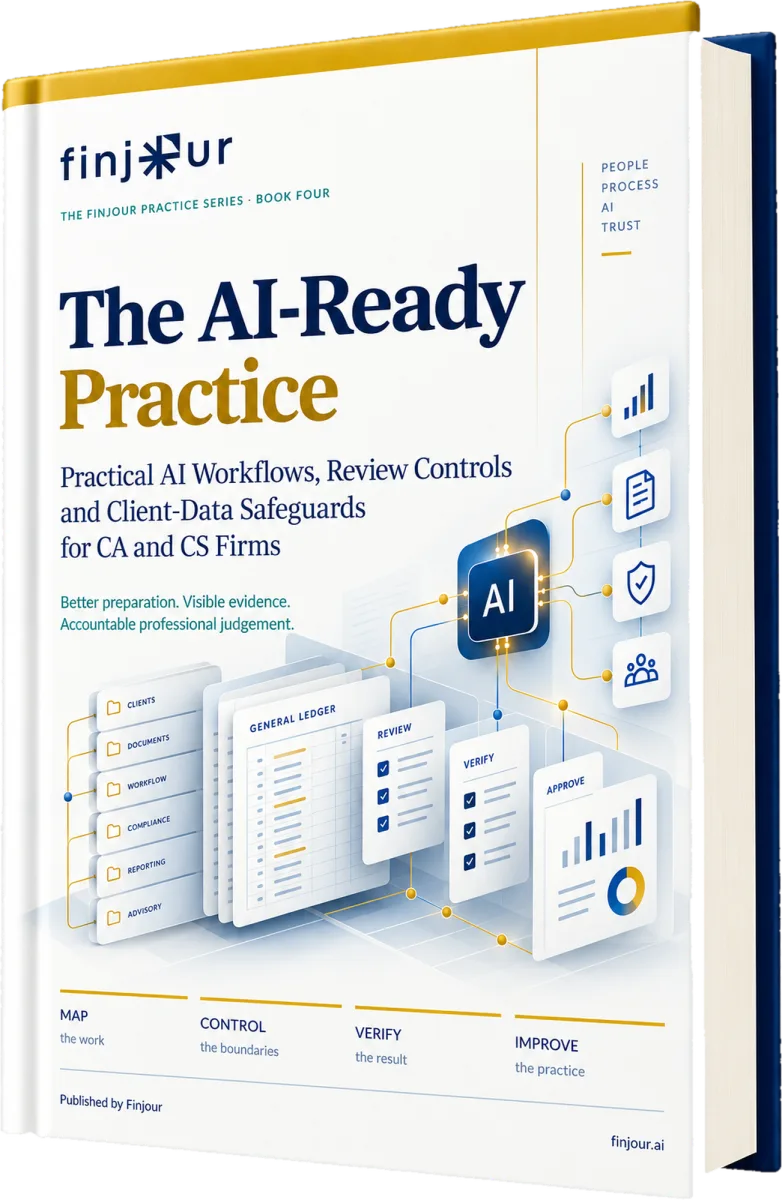
A practical visual guide for CAs, tax practitioners and CSs: use AI on client work, check what it produces, and free time for advisory work.
Book Four of the Finjour Practice Series. Sources checked to 16 October 2026.
What You'll Learn
Take a Sneak Peek
Compliance volume is a thin base for a practice
Most practices still earn most of their fees from routine work: returns, reconciliations, filings and records. If that work gets faster or smaller, the hours have to go somewhere better. AI can release them, but only if the firm can rely on what it produces. These are the four gaps that stop it.
01
A plausible answer passes for a supported one
A language model writes fluent sentences whether or not the records support them. Chapter 2 separates the four things AI does (generate, retrieve, calculate, act), and each needs a different check before anyone relies on it.
02
The firm automates a task nobody mapped
A ninety-minute task is often 150 minutes once review and correction are counted. Chapters 3 to 5 map the whole job first, choose workflows you can supervise, and measure the business case on the full time, not the preparer's screen time.
03
Client data leaves the desk without a boundary
An 'anonymised' ledger still carries bank references, narrations and a hidden payroll sheet. Chapters 7 to 9 cover data minimisation, approving a specific configuration rather than a brand name, and permissions and retention.
04
Nobody tested what happens when it fails
Nineteen neat outputs out of twenty looks like 95% accuracy. One invented deadline makes that number meaningless. Chapter 10 builds an acceptance set that shows the important errors before a client ever sees them.
A citation-shaped sentence is not a verified citation.
— Chapter 18
The responsibility stays with the professional. A tool can change how work is prepared. It does not change who answers for it.
Your practice needs this book if any of these are true
From AI by habit to AI by method
The book does not ask you to slow down or ban anything. It asks you to design the work: a purpose, minimum inputs, a controlled preparation step, an acceptance rule, a human decision and a record.
AI by habit
AI by method
How the book makes you measure it
The book does not promise savings. It shows how to count them honestly, with one illustrative workflow carried from Chapter 5 to Chapter 27. The figures below are the book's fictional teaching case, not a benchmark.
And then the line most AI pitches leave out: nothing in that calculation proves an extra ₹12,000 reached the bank. Chapter 27 shows how to tell released capacity, cash saved and new contribution apart.
Rated by founders, professionals and students
Why this handbook exists
Most of what is written about AI for accountants is either a tool list or a warning. Neither tells a firm what to do on Monday with a real client file. The useful question is not whether AI can write the note. It is what process would let you rely on the part of the work it helped with.
Finjour has worked alongside Indian CA and CS firms since 2015. This volume sets out that process for a practice of any size: prepare with the tool, challenge with a reviewer, and keep the release decision with the professional who signs.
30
Chapters
in six parts
20
Templates
5
Interactive lessons
Sectorssole practitioners · CA firms · CS practices · firm operations and data leads
The five mistakes that make AI risky in a practice
Each one feels efficient at the time. That is why they spread through a firm before anyone notices.
Starting with the most impressive task
Choose on the task and its failure consequences. A plain evidence request with clear checks is a better first workflow than a complex tax reply.
Approving 'AI' instead of a configuration
A personal subscription is not a business environment, and a business plan is not automatically zero retention. Approve the exact product, account and settings.
Testing speed before failure
Build test cases for missing information, conflicting inputs and unreadable pages. One invented deadline matters more than nineteen neat outputs.
Trusting a citation you have not read
A search result or chatbot summary is a lead, not evidence. Read the actual authority and check its commencement and later changes.
Counting notional savings as profit
Released capacity is not cash. Decide how the hours will be used, and do not report payroll savings while staff work the same hours.

30
Chapters
116
Pages
20
Templates
5
Interactive lessons
“A single average hides the distinction.”
— Chapter 10
What You'll Walk Away With
Work you can rely on
₹8000Each workflow ends with an accepted output, a responsible person and a record of what happened, not a fast draft.
Client data kept in bounds
₹6000Data classes, an input-release checklist and a provider approval record for the exact product and settings you use.
Errors caught before the client sees them
₹5000An acceptance set built from missing, conflicting and boundary cases, with a defect log the reviewer can read.
An honest business case
₹5000Capacity released, cash saved and new contribution kept apart, so nobody reports savings that never reached the bank.
“A failed gate is a reason to pause, not to lower the standard to meet Day 90.”
— Chapter 28

7 Chapters of Actionable Content
116 pages of structured, India-specific reference material.
Why a practice is not a chatbot, what AI can do and why it can still be wrong, mapping the work before you automate it, choosing workflows you can supervise, and measuring the whole business case.
“Strong output quality does not compensate for unacceptable data handling.”
— Chapter 8
AI by habit vs AI by method
What this costs against what it settles — ₹2499
The book is ₹2,499. Set that against one client note that went out with an explanation the records never supported.
The AI-Ready Practice
Instant download. 30 days to download your copy.
- The full companion package: PDF, HTML edition, templates, labs and case files
- Instant download, yours to keep, no subscription
- Sources checked to 16 October 2026
Common Questions
No. It is a practical visual guide to the work around the tool, with 28 numbered visuals and worked cases: an accuracy figure that hides a critical miss, a revenue fall explained without inventing the cause, a cash-timing change, and the evidence behind a CS approval. Prompts appear in Chapter 21, as controlled work instructions with Template N.
Let AI prepare the work. Keep the judgement yours.
Thirty chapters, twenty templates, five interactive lessons and a full set of fictional case files. The method that lets a CA or CS firm use AI on client work and still stand behind every output.